
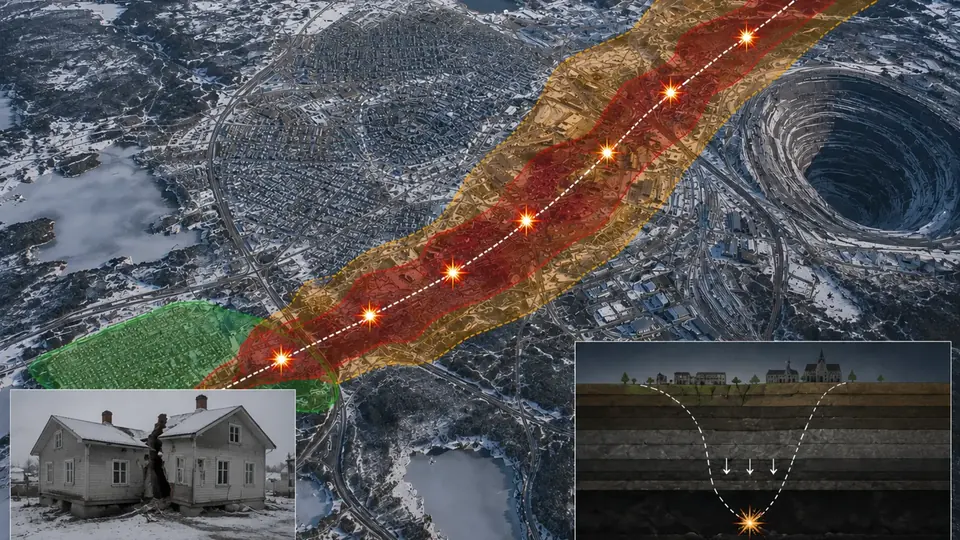
Why Kiruna Is Moving
Kiruna is moving because underground iron ore mining has caused long-term ground deformation that affects parts of the original city centre. The response is not to relocate every part of Kiruna at once, but to move or rebuild affected buildings, streets, services and infrastructure on stable ground while mining continues.
The city and the mine are inseparable. Kiruna developed around the iron ore deposits and the transport systems needed to move ore from northern Sweden. The same mining activity that created the modern city is also the reason its urban centre has had to change.
Kiruna is not moving because of a sudden disaster. It is undergoing a planned, long-term urban transformation in response to mining-related ground deformation.
Ground Deformation Explained
Ground deformation is the central technical reason for the relocation. As underground mining progresses, the rock mass above and around the mined areas gradually responds. Over time, this movement can affect the suitability of land for buildings, roads and other infrastructure.
For visitors, the important distinction is that this is a monitored long-term process rather than a sudden collapse scenario. Planning and relocation take place before affected urban areas become unsuitable for continued use.
| Question | Practical Answer |
|---|---|
| Is Kiruna falling into a hole? | No. The relocation responds to gradual, monitored ground deformation linked to underground mining. |
| Is the entire city moving? | No. Selected affected areas, buildings and city functions are relocated or rebuilt over time. |
| Why move before visible damage occurs? | The purpose is long-term planning: urban functions are moved before ground conditions become unacceptable. |
| Does mining continue? | Yes. The relocation allows affected urban areas and ongoing mining to be managed in parallel. |
What Is Actually Being Moved?
“Moving Kiruna” can sound as if the entire city is being lifted and transported elsewhere. In reality, the transformation combines several different approaches. Some buildings are physically relocated, some are replaced by new buildings, and some city functions move into newly developed areas.
This is why visitors can encounter both continuity and change at the same time. Historic structures may appear in new locations, while streets and commercial functions that once defined the old centre are replaced by a newer urban layout.
The most useful way to understand the transformation is to think in terms of affected areas and city functions rather than imagining one single moment when “Kiruna moves.”
How the LKAB Mine Fits Into the Story
LKAB, Sweden’s state-owned mining company, operates the Kiruna iron ore mine. Mining is the historical foundation of modern Kiruna and remains central to the city’s economy, infrastructure and long-term planning.
The mine is therefore not a separate attraction from the relocation story. It is the underlying reason the transformation is happening. Travelers who want more detail on the underground operation can continue with our guide to the LKAB mine in Kiruna.
Kiruna’s development is also tied to rail infrastructure and the export of iron ore toward Narvik. For broader historical context, see the complete history of Kiruna.
Kiruna Relocation Timeline
The relocation is a multi-stage process rather than a single construction project. The milestones below provide a simple framework for understanding how mining, planning and the new centre fit together.
| Period | What Changed |
|---|---|
| Early 1900s | Kiruna developed around iron ore mining and the railway system serving the mining region. |
| 2000s | Long-term relocation planning became necessary as mining-related ground deformation affected future land use. |
| 2010s | Major infrastructure and urban transformation work advanced as the new city structure took shape. |
| 2022 | The new city centre was inaugurated. |
| 19–20 August 2025 | Kiruna Church was moved as part of the continuing transformation. |
| Ongoing | City functions, buildings and affected areas continue to change as the long-term relocation proceeds. |
For a more detailed historical sequence, read the Kiruna city relocation history guide.
The New City Centre
Kiruna’s new city centre was inaugurated in 2022 and now forms the main urban focus for many services and everyday activities. It represents the most visible result of the relocation for visitors arriving today.
The move is not simply a copy of the former centre. New streets, buildings and public spaces have been developed while selected elements of older Kiruna are preserved or relocated. This creates a city where the transformation itself is part of what visitors experience.
The new centre is not evidence that old Kiruna disappeared overnight. The city has been changing in stages, with old and new urban areas coexisting during the transition.
Kiruna Church Relocation
Kiruna Church became the most recognizable individual building move in the transformation. The church was relocated over two days, 19–20 August 2025.
Its move is important because the relocation is not only about roads, offices and commercial buildings. It also affects places connected to local history and identity. Moving the church made the scale of the transformation visible in a way that abstract discussions about ground deformation rarely can.
Old Kiruna vs New Kiruna
Visitors should not expect a simple choice between an “old city” and a completely separate “new city.” Kiruna is best understood as a city in transition, where different parts of the urban landscape represent different stages of the move.
| Old Kiruna | New Kiruna |
|---|---|
| Shows the city’s earlier urban structure and mining-era development. | Contains the newer urban centre and relocated or newly built functions. |
| Some areas remain while others have changed, closed or been removed. | Continues to develop as the long-term transformation proceeds. |
| Helps explain what the relocation has changed. | Shows how Kiruna is adapting to future land-use constraints. |
Is Kiruna Safe to Visit?
Yes. The relocation is a planned response to monitored ground deformation, and normal visitor areas continue to function. The fact that parts of the city are being moved should not be interpreted as an immediate collapse risk across Kiruna.
Visitors should still respect construction zones, closures and local signage, just as they would in any city undergoing major redevelopment. The relocation affects specific areas and evolves over time.
Kiruna remains a functioning Arctic city. The urban move is preventive long-term planning around specific mining-affected areas, not a citywide emergency.
What Visitors Can See Today
The city transformation is visible without needing a specialist engineering background. Visitors can experience the new city centre, see relocated buildings and understand how urban planning has responded to the mine.
- The new city centre inaugurated in 2022
- Kiruna Church in its relocated position
- Buildings and city functions that have moved from affected areas
- Remaining parts of older Kiruna that show the city’s previous structure
- The wider relationship between the mine, railway and urban landscape
The experience is strongest when the relocation is placed in context rather than treated as a single sightseeing stop. A broader Kiruna travel guide can help combine the city story with the region’s other attractions and activities.
How the Move Affects Local Identity
The relocation is an engineering and planning project, but it is also a social change. Streets, buildings and landmarks can carry memories that are not reproduced simply by constructing new replacements.
At the same time, Kiruna’s mining identity remains central to the city. The transformation therefore contains a tension that visitors should understand: the industry that shaped Kiruna’s growth is also the reason familiar parts of the city have had to move.
For travelers, the city move becomes more meaningful when it is viewed as a community transition rather than a construction spectacle. The visible engineering is only one part of the story.
Common Misunderstandings
| Misunderstanding | More Accurate View |
|---|---|
| “The whole city is being moved.” | Only affected areas, buildings and functions are being relocated or rebuilt. |
| “Kiruna is collapsing.” | The move is a planned response to gradual, monitored ground deformation. |
| “The relocation is finished.” | The transformation is ongoing even though the new city centre is already in use. |
| “The church move was the whole project.” | The church was one highly visible milestone within a much larger urban transformation. |
| “The mine and the city are separate stories.” | The mine is the reason modern Kiruna developed and the reason affected urban areas are now being relocated. |
How to Include the City Move in a Visit
You do not need a full day devoted only to urban transformation to understand the story. For many travelers, a walk through the new centre combined with time to understand the mine and older parts of Kiruna is enough to make the relocation visible and understandable.
If your itinerary is short, combine the city story with another central Kiruna activity. If you have more time, add the mine context and the city’s broader history. Our guide to how many days you need in Kiruna can help place this into a wider itinerary.
Travelers arriving independently can also use the Kiruna transport guide when planning how the city fits into a longer Swedish Lapland trip.
Final Understanding
Kiruna is moving because continued underground iron ore mining changes the long-term stability of specific areas near the original city centre. The solution has been a phased urban relocation: move or rebuild affected functions on stable ground while allowing Kiruna to continue as both a working mining city and a place where people live, work and visit.
The new city centre, the moved church and the changing relationship between old and new Kiruna make this transformation unusually visible. Understanding that connection between geology, mining and urban planning gives visitors a much clearer picture of why Kiruna looks the way it does today.
Explore More of Kiruna
After understanding the city move, continue with Kiruna’s Arctic landscapes and activities.