
Kiruna Tours Arctic Header

Culture · Kiruna · 12 min read

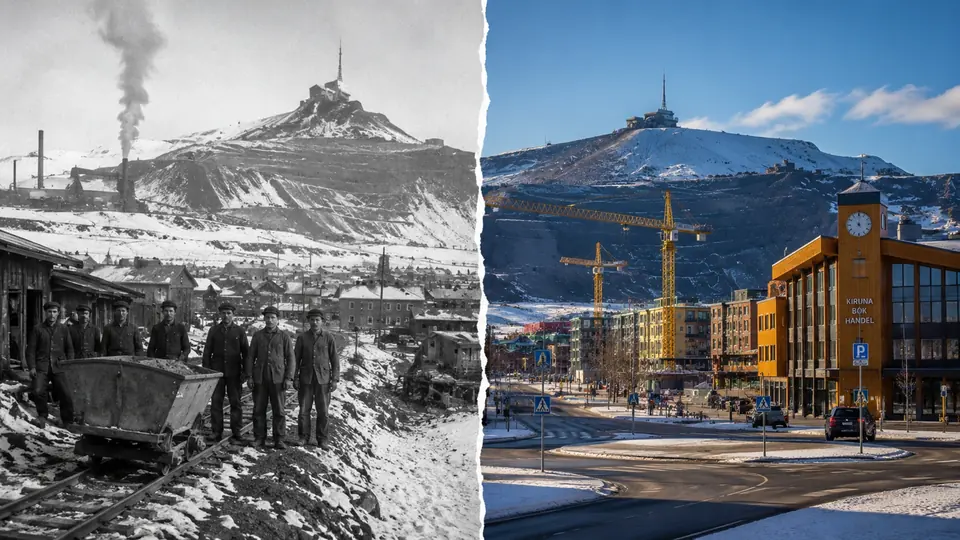
Kiruna’s Mining History & City Relocation

A local guide to the iron ore mine that created Kiruna, the ground deformation that forced the city to move, and the new Arctic city centre now rising east of the old town.

Quick Answer

Kiruna is moving because underground iron ore mining has caused ground deformation near the old city centre. The mine created Kiruna’s economy, but continued extraction beneath Kiirunavaara means many homes, streets and public buildings cannot safely remain where they were built.

Key Facts

  • Main reason: LKAB’s underground mine and ground deformation.
  • New centre: about 3 km east of the old centre.
  • Most famous moved building: Kiruna Church.
  • Best visitor approach: see both old relocation areas and the new city centre.
  • Key context: mining, Sámi land use, heritage preservation and Arctic urban planning all overlap here.

Key Facts

Founded Around LKAB mine
Move Direction About 3 km east
Key Site Kiirunavaara
Visitor Focus Old + new city

Short Answer Summary

Kiruna is one of the clearest examples in Europe of a city reshaped by mining. The relocation is not a tourist theme park. It is a real urban transformation affecting homes, public services, cultural landmarks and Sámi reindeer-herding landscapes.

Why Is Kiruna Moving?

Kiruna is moving because parts of the old town are affected by ground deformation linked to underground mining. The deformation is gradual, monitored and managed, but it makes long-term use of some buildings and infrastructure unsafe.

The city was built close to the Kiirunavaara ore body because the mine was the reason Kiruna existed. More than a century later, the mine has continued deeper underground. That has changed the stability of the land around older neighbourhoods.

The short version is simple: the mine made Kiruna possible, and the mine is also why the old city centre cannot stay where it was.

How Did Mining Create Kiruna?

Kiruna’s modern history begins with the iron ore of Kiirunavaara and Luossavaara. The ore was known before industrial mining began, but the real transformation came when large-scale extraction and railway transport became possible.

Kiruna was not an old agricultural town that later found a mine. It was planned as a mining community from the start. Housing, roads, public institutions and cultural buildings grew around LKAB’s operations and the railway connection to the coast.

Hjalmar Lundbohm, LKAB’s early managing director, shaped much of the original town vision. He wanted more than a rough mining camp. The early plan included public services, quality architecture and a strong civic identity.

Local Insight: Kiruna Was Planned, Not Random

Many visitors imagine old mining towns as messy industrial settlements. Kiruna was different. Its early identity combined mining, social planning, architecture and Arctic adaptation. That is why the relocation feels so emotional for many residents.

What Is LKAB?

LKAB, Luossavaara-Kiirunavaara Aktiebolag, is the mining company at the centre of Kiruna’s development. Its operations have shaped the town’s economy, housing, transport, labour market and long-term planning.

For visitors, LKAB is not only a company name on signs. It is the reason Kiruna exists as a modern city. It is also the actor responsible for much of the relocation process connected to mining deformation.

The mine remains one of the largest and most important industrial sites in northern Sweden. It also explains why Kiruna is not only a Northern Lights destination; it is an industrial Arctic city with a living transformation story.

What Caused the Ground Deformation?

The Kiruna mine uses underground mining methods that allow broken rock above mined areas to move in a controlled way. Over time, this movement affects the rock mass above and around the ore body.

The deformation does not mean the city suddenly falls into a hole. It means cracks, movement and stress zones progress through the ground over time. When those zones approach buildings, roads and utilities, the area can no longer be treated as stable for permanent urban use.

TermWhat It MeansWhy It Matters for Kiruna
Ore bodyThe underground mass of iron ore beneath Kiirunavaara.Its shape and depth determine where mining can continue.
Sublevel cavingA mining method where ore is extracted and surrounding rock moves downward.Efficient for ore extraction, but creates surface deformation over time.
Deformation zoneThe area where ground movement affects land and buildings.This zone decides which parts of the city must be relocated or closed.
GruvstadsparkA transition park between mining areas and remaining city areas.It manages safety, memory and land-use transition.

Kiruna Relocation Timeline

The relocation is not a single moving day. It is a long process involving geology, planning, compensation, demolition, construction, heritage management and public services.

1890
LKAB is founded, setting the stage for large-scale industrial development in Kiruna.
1898–1903
The Iron Ore Line connects Kiruna with export routes, making remote mining economically possible.
1900s
Kiruna develops as a planned mining town with housing, services and civic buildings.
1912
Kiruna Church is completed, becoming one of the town’s strongest cultural landmarks.
1970s
Early signs of ground deformation appear away from the city centre.
2004
LKAB warns Kiruna Municipality that mining-related deformation will affect urban areas.
2011
The new city centre location east of the old centre is selected.
2017
Several historic buildings begin moving to new locations.
2018
Kristallen, the new city hall, opens in the new centre.
2022
The new city centre is inaugurated with shops, services and cultural facilities.
2025
Kiruna Church relocation becomes the most visible symbol of the transformation.
2030s
The relocation continues as affected areas are phased out and new neighbourhoods develop.

What Is the New Kiruna City Centre Like?

The new centre is designed to be denser, more walkable and more concentrated than the old spread-out town centre. It includes civic buildings, shops, cultural facilities, apartments, public space and services.

Kristallen, the new city hall, was one of the first major symbols of the move. The new centre also includes shopping galleries, cultural venues and public meeting places intended to make the city feel active despite winter darkness.

Some residents appreciate the clearer centre and new facilities. Others miss the old streets, old buildings and social memory of the former centre. Both reactions are part of the story.

Local Insight: The New Centre Feels Different

Visitors often ask whether the new centre is “better” or “worse.” That is too simple. It is newer, more compact and more planned. But the old centre carried decades of memory. Kiruna is not just relocating buildings; it is rebuilding habits.

Which Historic Buildings Have Moved?

Not every old building can be moved. Some are demolished, some are documented, and selected cultural buildings are relocated to preserve part of Kiruna’s built heritage.

Moved or planned-to-move buildings include early worker housing, civic buildings and cultural landmarks associated with the town’s mining-era identity. The exact status of individual buildings can change as costs, planning and preservation decisions develop.

Building or AreaWhy It MattersVisitor Relevance
Kiruna ChurchOne of Sweden’s best-known wooden churches and a key symbol of the relocation.Essential stop when accessible in its new location.
Hjalmar LundbohmsgårdenLinked to the early vision and leadership behind Kiruna.Important for understanding the planned mining-town identity.
Historic worker housingShows how early mining communities lived.Useful for visitors interested in labour and social history.
Old city centre blocksRepresent the emotional loss behind the relocation.Often best understood with a local guide.
New city hall KristallenSymbol of the new centre and municipal transition.Good first stop in the new Kiruna.

Why Was Kiruna Church Moved?

Kiruna Church was moved because it stood within an area affected by the relocation process. The church is one of Kiruna’s most important buildings, so preserving it mattered culturally, historically and emotionally.

The move required careful engineering, route preparation and heritage handling. A building like this cannot simply be lifted casually. Weight, structure, weather, road width, utilities and destination foundations all matter.

For many residents, the church move carried mixed feelings. It showed that Kiruna’s heritage would not simply be abandoned. It also made the loss of the old town visible in a very public way.

How Does the Move Affect Sámi Reindeer Herding?

Kiruna sits within Sápmi, the traditional homeland of the Sámi people. Mining, roads, tourism, railways, power lines and new urban areas all place pressure on reindeer-herding landscapes.

The relocation cannot be understood only as an engineering story. It is also a land-use conflict story. Reindeer migration, grazing, calving areas and seasonal movement all depend on access to connected landscapes.

Responsible travel in Kiruna means recognizing that the city transformation sits on land with older histories than the mining town itself. Visitors should treat Sámi culture as living culture, not decoration around a mining story.

How Can Visitors Experience the Transformation?

Visitors can experience Kiruna’s transformation by combining the new centre, remaining old-city areas, LKAB-related interpretation and guided local context. This is not something you fully understand by walking around for ten minutes.

Start at the new centre to see where Kiruna is going. Then visit areas connected to the old centre and mine story. Add the church site or relocated buildings when accessible. If possible, take a guided city or mine-history tour.

  • Walk through the new city centre and Kristallen area.
  • Look for relocated heritage buildings and public information signs.
  • Compare old street memory with new urban layout.
  • Visit LKAB-related exhibitions or viewpoints when open.
  • Combine the city story with the complete history of Kiruna for wider context.

Comparison Tables

These tables help visitors understand the relocation in practical terms.

Old KirunaNew KirunaWhat This Means
Built close to the original mining area.Built farther east on more stable land.The move prioritizes long-term safety and continued urban life.
More historic street memory.More planned, compact centre.Visitors should see both to understand the trade-off.
Some areas closed, demolished or transformed.New services, housing and public buildings.The city is changing while still functioning.
Emotionally important for residents.Practical future base for the municipality.The relocation is both loss and adaptation.
Visitor InterestBest Place to FocusBest Pairing
Mining historyLKAB story, Kiirunavaara and mine viewpoints.Inside the LKAB Mine in Kiruna
Urban planningNew city centre and Kristallen.Why Kiruna Is Moving the City
ArchitectureKiruna Church and moved heritage buildings.The Complete History of Kiruna
Sámi contextLand-use and reindeer-herding interpretation.Sámi Culture in Swedish Lapland

Problem: Visitors Treat the Relocation as a Simple Attraction

The main problem is oversimplification. Some visitors see the relocation as a strange engineering attraction: “a city that moves.” That misses the human and cultural complexity.

Solution: Understand the Layers

Approach Kiruna’s relocation as four stories at once: mining history, urban planning, heritage preservation and land-use conflict. That makes the experience more honest and more useful.

Kiruna Relocation Visitor Checklist

  • See the new centre first, then compare it with old relocation areas.
  • Read basic mining history before your visit.
  • Do not assume all old buildings were saved.
  • Remember that the move affects real residents, not only buildings.
  • Include Sámi land-use context when discussing the transformation.
  • Use a guided tour if you want the full story in limited time.

Common Mistakes Visitors Make

  • Thinking the entire city moved in one piece.
  • Assuming Kiruna is an abandoned town.
  • Confusing the old centre, new centre and mine area.
  • Ignoring the Sámi reindeer-herding context.
  • Expecting all historic buildings to be accessible every day.
  • Visiting only the new centre and missing the old-city story.
  • Treating mining as background rather than the reason Kiruna exists.

Realistic Expectations

Kiruna’s relocation is fascinating, but it is also messy in the real-world sense. Some areas look finished. Other areas look like construction zones, demolition areas or temporary transition spaces.

That contrast is part of the experience. You are not visiting a polished open-air museum. You are visiting a working Arctic municipality adapting to an industrial reality.

Winter visitors should also remember that short daylight, cold weather and snow can make walking between sites slower. During polar night, around December 11–12 to January 1–2, Kiruna still has roughly 3–4 hours of twilight or blue-hour light, not complete darkness all day.

Final Verdict: Is Kiruna’s City Relocation Worth Seeing?

Yes. Kiruna’s relocation is one of the most unusual urban transformations in Europe and one of the clearest ways to understand how deeply mining shapes life in northern Sweden.

It is worth seeing if you are interested in history, engineering, Arctic society, architecture, land use or the future of resource towns. It is not only a side activity between Northern Lights tours. It is one of Kiruna’s defining stories.

Explore Kiruna with Local Context

Use guided tours and local planning to connect Kiruna’s city transformation with the wider Arctic landscape, mining history and winter travel experience.

Sources and Further Reading

These sources were selected because they provide official, institutional or relevant background information on Kiruna’s urban transformation, mining history, Sámi context and Arctic planning.

Frequently Asked Questions

Why is Kiruna moving?

Kiruna is moving because underground iron ore mining has caused ground deformation that affects parts of the old city. Relocation allows the city to continue functioning on more stable land.

How far is Kiruna moving?

The new city centre is about three kilometres east of the old centre. Not every part of Kiruna is moving at once, and some areas remain in use during the transition.

Is the entire city of Kiruna moving?

No. The relocation affects major parts of the old centre and several neighbourhoods, but Kiruna continues to function as a municipality throughout the process.

What is LKAB?

LKAB is the mining company behind the iron ore operations that created modern Kiruna and are also connected to the deformation that requires relocation.

Was Kiruna Church moved?

Yes. Kiruna Church is one of the most important heritage buildings connected to the relocation and has become the best-known symbol of the city move.

Can visitors see the city relocation?

Yes. Visitors can see the new city centre, relocated buildings, parts of the old transformation area and mine-related interpretation. A guided tour gives the clearest context.

Is Kiruna safe to visit during the relocation?

Yes. Public visitor areas are managed and signed. Do not enter closed demolition, construction or deformation areas.

How does the relocation relate to Sámi culture?

The relocation takes place in Sápmi, where reindeer herding and Sámi land use are affected by mining, infrastructure and urban development. This context is essential to understanding the full story.

When is the best time to visit Kiruna for this history?

Summer gives easier walking and long daylight. Winter adds Northern Lights, snow and a stronger Arctic atmosphere, but short daylight and cold require more planning.