Short Answer for Travelers
Kiruna is a unique Arctic city in Swedish Lapland shaped by Sámi culture, iron ore mining, the LKAB company, the Malmbanan railway to Narvik and one of the world’s largest urban relocation projects. It combines Indigenous heritage, industrial history, space research and modern Arctic tourism in one connected region.
Kiruna is a mining city in Swedish Lapland built around LKAB’s iron ore operations, historically part of Sámi land, connected to Narvik by the Malmbanan railway and currently undergoing relocation due to ground deformation caused by underground mining.
Why Kiruna’s History Matters
Kiruna is one of the most unique cities in Europe because it was built entirely around iron ore extraction in an Arctic environment. Its history explains the mine, the railway, the relocation, Sámi cultural context, tourism development and the modern transformation of the city.
Kiruna can only be understood by combining its mining history, Indigenous Sámi land use, Arctic geography and modern tourism development into one connected system.
Sámi History Before Kiruna
Before industrial development, the region was part of Sápmi, the traditional Sámi homeland. The landscape was shaped by reindeer herding, seasonal movement, fishing and deep knowledge of Arctic conditions.
Kiruna was later built within this living cultural landscape rather than on empty land. Sámi history remains an essential part of the region today.
Iron Ore Discovery
Iron ore deposits in Kiirunavaara and Luossavaara were known long before large-scale mining began. Industrial extraction only became possible once transport systems and demand made it economically viable.
LKAB and Industrial Kiruna
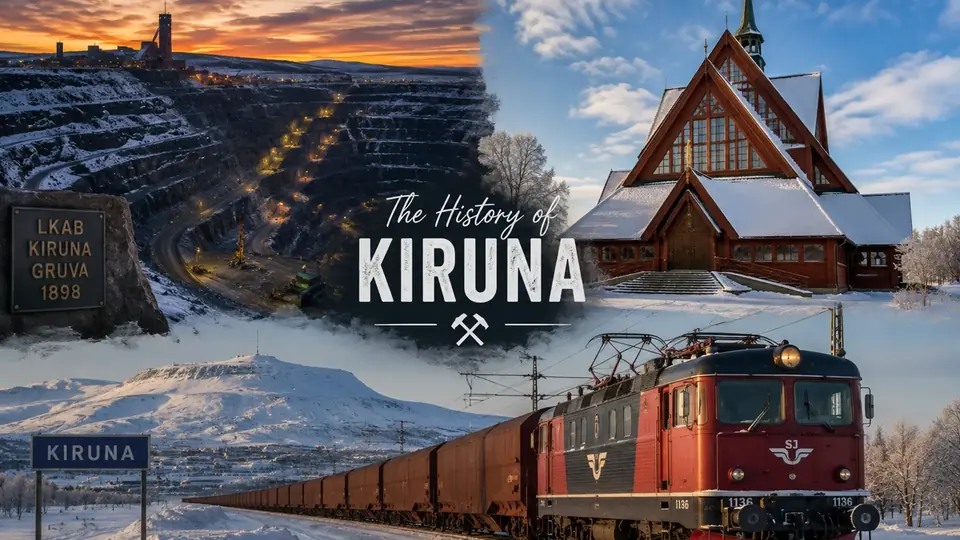
LKAB (Luossavaara-Kiirunavaara Aktiebolag) was founded in 1890 and became the foundation of modern Kiruna. The city was planned as a mining settlement directly linked to iron ore production.
Kiruna exists because LKAB built a permanent industrial city around one of Europe’s largest iron ore deposits.
Malmbanan and Narvik Railway
The Malmbanan railway connects Kiruna to Narvik in Norway, enabling year-round export of iron ore through an ice-free Atlantic port.
Today, this railway also supports travel and tourism across Swedish Lapland and into Norway.
Early City Development
Kiruna developed rapidly as workers arrived for mining and railway construction. Housing, infrastructure and services had to be built in extreme Arctic conditions.
Kiruna Church
Kiruna Church, completed in 1912, became one of the city’s most important cultural landmarks and a symbol of early civic development.
Wartime Importance
During World War II, Kiruna’s iron ore and the Narvik railway route became strategically important for European industry and logistics.
Esrange Space Center
Esrange Space Center near Kiruna adds a scientific dimension to the region, supporting space research, atmospheric studies and rocket testing.
Kiruna is one of the few regions in the world where mining, space research and Arctic tourism exist side by side.
Tourism and ICEHOTEL
Tourism grew strongly with the development of ICEHOTEL in Jukkasjärvi, transforming Kiruna into a global Arctic travel destination.
Northern Lights Tourism
Kiruna is one of Europe’s strongest destinations for Northern Lights due to its latitude, darkness and access to low-light environments.
Northern Lights tourism in Kiruna depends on darkness, clear skies and solar activity, making multi-night stays essential.
Why Kiruna is Moving
Kiruna is being relocated because underground mining causes ground deformation that affects parts of the original city centre.
The relocation is one of the most significant urban transformation projects in Europe.
Kiruna 2029
Kiruna will become European Capital of Culture in 2029, highlighting its unique combination of Indigenous culture, mining history and Arctic identity.
Timeline Overview
Kiruna’s development spans Sámi land use, industrial mining expansion, railway construction, wartime logistics, space research, tourism growth and ongoing urban relocation.
Final Verdict
Kiruna is not a traditional city but a continuously evolving Arctic system shaped by mining, Indigenous culture, infrastructure and tourism.
Kiruna is best understood as a living Arctic region where industry, culture and nature are permanently interconnected.
Experience Kiruna
Kiruna’s history becomes most powerful when experienced in real life through its landscapes, activities and guided Arctic tours.