
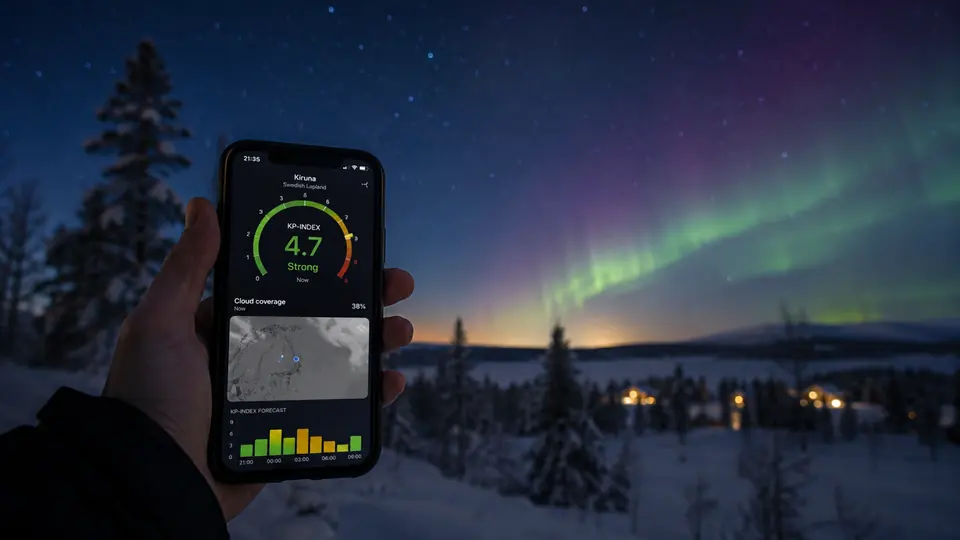
What a Northern Lights Forecast Actually Shows
A Northern Lights forecast combines two separate questions: what is happening in space, and whether local conditions allow you to see it from the ground. Space-weather indicators describe geomagnetic activity, while cloud cover, darkness and local light pollution determine whether that activity is visible from your location.
This distinction matters in Kiruna and Abisko because a strong aurora forecast can still produce no visible result beneath heavy cloud. At the same time, moderate geomagnetic activity can be worth watching when the sky is clear and dark.
The most useful rule is simple: check whether you can see the sky first, then use KP, solar wind and Bz to understand the aurora potential above it.
For broader seasonal context, see our guide to the best time to see Northern Lights in Kiruna. Forecast interpretation is most useful once you already understand that darkness and weather are fundamental parts of aurora viewing.
What Should You Check First?
| Priority | Forecast Factor | Why It Matters |
|---|---|---|
| 1 | Cloud cover | Heavy cloud can block the aurora completely. |
| 2 | Darkness and local light | A dark sky improves contrast and makes weaker displays easier to see. |
| 3 | KP index and auroral oval | These help describe the scale and location of geomagnetic activity. |
| 4 | Solar wind and Bz | These can help explain short-term changes in activity. |
| 5 | Regional conditions | Nearby areas can have different cloud cover during the same evening. |
No single number should decide whether you go outside. A useful forecast is a combination of visibility, darkness and space-weather signals.
How to Read the KP Index
KP is a global geomagnetic index measured on a scale from 0 to 9. Higher values indicate stronger global geomagnetic disturbance and can allow aurora to be visible farther from the polar regions.
In far northern locations such as Kiruna and Abisko, KP should not be treated as a minimum threshold. These destinations sit close to the auroral oval, so visible aurora can occur during lower or moderate KP values when local conditions are favorable. A value around KP 2–3 can still coincide with visible aurora under dark, clear skies.
KP also does not directly predict how colorful, fast-moving or visually dramatic a display will look. It is one part of the space-weather picture, not a guaranteed brightness score.
| KP Situation | How to Interpret It in Kiruna |
|---|---|
| Low KP | Do not automatically give up if the sky is clear and dark. |
| Moderate KP | Worth monitoring closely when local weather is favorable. |
| High KP | Stronger geomagnetic activity may be present, but clouds can still block the view. |
Why Cloud Cover Often Matters More Than KP
Cloud cover is the most important local visibility factor. The aurora occurs high above the weather, so thick cloud between you and the sky can hide even strong activity.
Broken cloud is different from complete overcast. Openings can appear and move during the evening, which means a partly cloudy forecast may still be worth monitoring. This is one reason local flexibility can be more useful than staring at a single aurora percentage.
| Forecast Combination | Practical Interpretation |
|---|---|
| High KP + heavy cloud | Poor local visibility despite strong activity above the cloud. |
| Moderate KP + clear sky | A useful situation to watch in Kiruna and Abisko. |
| Low KP + clear sky | Still worth checking the sky in a dark location. |
| Broken cloud + changing activity | Stay flexible and watch for clear gaps. |
What Solar Wind and Bz Mean
Solar wind is the continuous flow of charged particles from the Sun toward Earth. Changes in its speed and magnetic properties can influence geomagnetic activity and help explain why an evening becomes more or less active.
Bz describes the north-south orientation of the interplanetary magnetic field carried by the solar wind. A negative, or southward, Bz is generally more favorable for transferring energy into Earth's magnetic environment. That can improve aurora potential, although it still does not guarantee a visible display from the ground.
For travelers, the practical value of solar-wind and Bz data is short-term context. They are most useful when combined with clear skies rather than treated as reasons to ignore the weather forecast.
Key Space-Weather Terms
| Term | Meaning | Why Travelers See It in Forecasts |
|---|---|---|
| Auroral oval | The region around Earth's magnetic poles where aurora is commonly observed. | Kiruna and Abisko are close to this zone. |
| KP index | A global measure of geomagnetic disturbance. | Useful for judging the wider scale of activity. |
| Solar wind | Charged particles flowing from the Sun. | Changes can affect short-term geomagnetic conditions. |
| Bz | The north-south component of the interplanetary magnetic field. | Negative Bz is generally more favorable for aurora activity. |
| CME | A coronal mass ejection from the Sun. | Some CMEs can lead to stronger geomagnetic activity when they reach Earth. |
| Geomagnetic storm | A disturbance in Earth's magnetic field. | Can expand aurora visibility farther from the polar region. |
How to Read Forecasts for Kiruna and Abisko
Kiruna and Abisko are close enough that the space-weather situation is broadly shared, but local cloud conditions can differ. This is why comparing regional weather can be more useful than comparing KP values between the two places.
Abisko is often discussed for local weather patterns that can create clearer sky windows than surrounding areas during some conditions. The effect is sometimes described as the “Blue Hole of Abisko.” It should be treated as a possible local weather advantage, not a guarantee of clear sky or Northern Lights.
If you are deciding where to base your aurora nights, our Kiruna vs Abisko for Northern Lights guide compares the broader travel trade-offs beyond the forecast itself.
- Compare cloud forecasts for Kiruna and Abisko.
- Look for dark, clear viewing conditions rather than chasing the highest KP number.
- Recheck conditions during the evening because clouds and space weather can change.
- Consider road and weather safety before moving between viewing areas.
- Dress for waiting outdoors, not only for walking between buildings.
Should You Trust Aurora Apps?
Aurora apps are useful as alert and monitoring tools, but many simplify several variables into one percentage or score. That can make them easy to use and easy to misread.
A strong app score does not override heavy cloud, and a weak percentage does not automatically mean a clear night is worthless in northern Sweden. Cross-checking an aurora app with an official weather forecast and a reliable space-weather source gives a more realistic picture.
| Tool | Best Use | Main Limitation |
|---|---|---|
| Aurora app | Quick alerts and activity overview. | May oversimplify local visibility. |
| NOAA Space Weather Prediction Center | Space-weather data and short-term aurora monitoring. | Requires more interpretation than a simple app score. |
| SMHI | Weather, cloud and local conditions in Sweden. | Local cloud can still change faster than a forecast suggests. |
Does Moonlight Ruin the Northern Lights?
Moonlight does not automatically ruin an aurora night. Bright moonlight can reduce contrast for faint aurora, but stronger displays remain visible. In snowy landscapes, moonlight can also illuminate the foreground and add detail to photographs.
For most travelers, cloud cover and darkness from the season matter more than trying to plan an entire trip around a specific moon phase.
How Accurate Are Northern Lights Forecasts?
Short-term information is generally more useful than long-range aurora predictions. Space weather and local cloud can both change, so a same-evening check is more useful for a viewing decision than a forecast made many days in advance.
Longer-range forecasts are still useful for broad planning, especially for identifying potentially active periods, but they should not be treated as guarantees. The closer you get to the evening itself, the more useful local cloud information and current space-weather data become.
Use long-range aurora forecasts for expectations, and short-range weather plus current space-weather conditions for the actual evening decision.
A Practical Northern Lights Forecast Workflow
- Check darkness: make sure you are traveling during a season and time when the sky is dark enough.
- Check cloud cover: identify the clearest nearby area before looking at aurora numbers.
- Check KP and the auroral oval: use them to understand the wider geomagnetic situation.
- Check solar wind and Bz: use them as supporting short-term signals.
- Reduce local light: choose a darker viewing location when practical and safe.
- Recheck conditions: do not assume the first forecast of the evening will remain unchanged.
- Stay patient: aurora activity can strengthen or weaken during the same night.
For location ideas, continue with our guide to Northern Lights viewing places near Kiruna.
Common Northern Lights Forecast Mistakes
- Checking KP while ignoring cloud cover.
- Treating a high KP value as a guarantee.
- Assuming low KP means there is no reason to look outside in Kiruna.
- Trusting one app percentage without checking local weather.
- Confusing geomagnetic activity with visible brightness.
- Leaving too early because the first part of the evening is quiet.
- Ignoring local light pollution.
- Planning around a forecast many days ahead as if it were fixed.
- Underdressing and becoming too cold to wait outdoors.
Realistic Expectations
A forecast improves decisions; it does not remove uncertainty. Northern Lights visibility depends on several variables that can change during the same evening. Even a favorable setup can disappoint if cloud arrives, while a modest forecast can still produce a memorable display under clear skies.
The best trip strategy is therefore broader than forecasting. Give yourself more than one opportunity, plan other Arctic experiences, and treat each aurora evening as a probability rather than a promise.
If you are new to the phenomenon itself, our guide to how the Northern Lights work explains the science behind what you are trying to forecast.
Final Verdict: How Should You Read an Aurora Forecast?
Start with local visibility: clear sky, darkness and a suitably dark location. Then use KP, the auroral oval, solar wind and Bz to understand the activity that may be occurring above you.
In Kiruna and Abisko, clear skies can matter more than an impressive KP number. The most useful forecast strategy is to compare local weather, use current space-weather data as supporting context, stay flexible and avoid treating any single app or index as a guarantee.