Fast Decision Guide
- Choose Abisko: if your trip is mainly about dark skies, aurora photography and quiet Arctic nature.
- Choose Tromsø: if you want restaurants, nightlife, fjords, museums and a more social winter atmosphere.
- Choose Kiruna + Abisko: if you want easier Swedish Lapland logistics together with dedicated aurora nights.
- Best for photographers: Abisko.
- Best for first-time Arctic city travel: Tromsø.
- Best pure aurora environment: Usually Abisko.
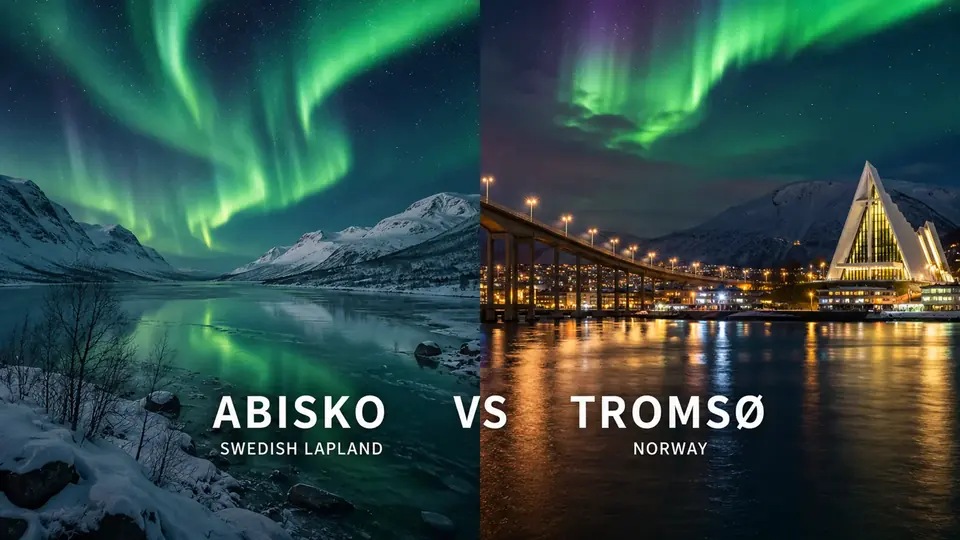
Abisko and Tromsø are two of the most famous Northern Lights destinations in Europe, but they offer very different travel experiences. This guide compares weather, photography conditions, scenery, logistics, costs and overall atmosphere to help you choose the destination that best matches your travel style and Northern Lights goals.
Where Are Abisko and Tromsø?
Abisko is located in Swedish Lapland approximately 100 km west of Kiruna, while Tromsø is located on an island in northern Norway above the Arctic Circle. Both destinations are among Europe's most famous Northern Lights locations but offer very different landscapes, infrastructure and travel experiences.
Abisko is best known for Abisko National Park, Lake Torneträsk, mountain scenery and its reputation for clearer winter skies. Tromsø is a larger Arctic city with a wider range of restaurants, hotels, museums, nightlife and year-round tourism services.
Although both destinations offer excellent Northern Lights opportunities, travelers often choose between them based on atmosphere. Abisko focuses on nature and wilderness, while Tromsø combines aurora tourism with city life and Norwegian fjord scenery.
Why This Comparison Matters
Abisko and Tromsø are often compared because both sit in the aurora zone and both have strong reputations with international travelers. The problem is that they are not similar travel products. Abisko is small, quiet and sky-focused. Tromsø is a city with a large tourism infrastructure.
That difference affects everything: how you spend evenings, how much backup you have in bad weather, how easy it is to eat out, how dark the viewing areas are and how much travel effort is needed before your aurora evening even begins.
The Main Difference Between Abisko and Tromsø
The simplest way to separate them is this: Abisko is built around the sky, while Tromsø is built around the city. In Abisko, the evening often means waiting outdoors in dark surroundings. In Tromsø, the evening often means joining a vehicle-based aurora chase that leaves the city to search for clearer weather.
Neither style is automatically better. Abisko suits travelers who accept quiet evenings and limited services in exchange for darker conditions. Tromsø suits travelers who want restaurants, hotels, fjords and more to do if the forecast is poor.
Quick Comparison Table
| Factor | Abisko | Tromsø | Practical Winner |
|---|---|---|---|
| Dark-sky conditions | Very strong, low light pollution. | City light affects weak displays unless you leave town. | Abisko |
| Weather flexibility | Good local clear-sky reputation, but limited mobility without car or guide. | Guided chases can drive long distances to find breaks in cloud. | Depends on tour style |
| Restaurants and nightlife | Limited. | Strong by Arctic standards. | Tromsø |
| Photography learning curve | Darker and simpler for beginners. | More dramatic scenery but harder light conditions near town. | Abisko for beginners |
| Fjord scenery | Mountain and lake scenery, no fjords. | Fjords, islands and coastal mountains. | Tromsø |
| Quiet atmosphere | Very strong. | More urban and social. | Abisko |
Weather and Clear Skies
Cloud cover is the biggest practical obstacle in both destinations. The aurora can be active above you, but if the sky is covered, you will not see it. This is why local weather and mobility matter as much as solar activity.
Abisko is known for the local clear-sky tendency often called the Blue Hole effect. It can improve the odds around Abisko compared with surrounding areas, but it is not a promise. Tromsø has a coastal climate, which can be milder but also wetter, windier and more changeable.
| Weather Factor | Abisko | Tromsø |
|---|---|---|
| Climate type | Inland Arctic and mountain-influenced. | Coastal Arctic and maritime-influenced. |
| Cloud challenge | Still possible, but often better clear-sky odds locally. | Often more variable, with frequent coastal cloud and wind. |
| Aurora strategy | Wait in dark locations when local sky is open. | Drive away from town and chase clearer weather. |
| Best planning mindset | Stay several nights and watch cloud cover carefully. | Book flexible chase tours and accept long evenings. |
Local Insight: Clear Sky Beats KP Obsession
Many first-time aurora travelers overvalue KP index. A moderate display under clear sky is more useful than a high forecast hidden behind cloud. Check local cloud cover before deciding whether a night is promising.
Darkness and Light Pollution
Abisko has a structural advantage: it is small and dark. You can usually reach darker surroundings more easily than in a city. This matters most when aurora is weak, because low light pollution improves contrast.
Tromsø can still show strong aurora, especially during active displays, but weaker arcs can be harder to see from town. Most serious aurora tours in Tromsø therefore leave the city lights behind.
Northern Lights Photography Comparison
Abisko is easier for clean dark-sky aurora photography. The compositions are usually built around Lake Torneträsk, snow, forest and mountain silhouettes. Tromsø offers a more dramatic coastal look, with fjords, islands and steep mountains, but beginners often struggle more with light pollution, moving tour schedules and coastal weather.
Lapporten and Arctic Landscape Differences
One of the biggest visual differences between Abisko and Tromsø is the landscape style around the aurora itself. Abisko is associated with open Arctic mountain terrain, frozen Lake Torneträsk and famous formations such as Lapporten. Tromsø is associated with fjords, islands, bridges and steep coastal mountains.
This matters because Northern Lights photography is not only about the sky. The foreground strongly affects the final experience and image quality. Travelers who want minimalist dark-sky compositions often prefer Abisko, while travelers wanting dramatic coastal scenery often prefer Tromsø.
| Landscape Type | Abisko | Tromsø |
|---|---|---|
| Primary scenery | Mountains, snowfields and Arctic lake landscapes. | Fjords, coastal mountains and islands. |
| Most famous landmark style | Lapporten and Lake Torneträsk. | Fjord viewpoints and coastal roads. |
| Best for minimalist aurora photography | Very strong. | Moderate. |
| Best for dramatic coastal compositions | Limited. | Excellent. |
Tour Style Differences
Abisko tours tend to be calmer and more location-based. The guide may choose a dark viewing area and focus on waiting, photography and interpreting conditions. Tromsø tours are often long vehicle-based chases, sometimes driving far inland or toward the Finnish border if coastal cloud is heavy.
That makes Tromsø more active and social, but also more tiring. Abisko feels simpler and quieter, but with fewer alternatives if the local sky closes completely.
Problem: Travelers Choose Based on Fame, Not Fit
The most common mistake is choosing the destination with the strongest online reputation without matching it to personal travel style. A city traveler may find Abisko too limited. A quiet nature traveler may find Tromsø too busy and bright.
Solution: Match the Destination to the Trip Goal
Choose Abisko for darker skies, quiet evenings and aurora-focused planning. Choose Tromsø for fjords, restaurants, city comfort and more backup activities. For pure aurora odds, plan several nights in either place and avoid judging the trip by one forecast.
Winter Atmosphere Comparison
Abisko feels sparse, quiet and nature-led. Tromsø feels lively, coastal and urban. This matters because the Northern Lights are never guaranteed; the surrounding experience must still make sense if the sky stays quiet.
- Abisko atmosphere: dark, quiet, small-scale, wilderness-oriented.
- Tromsø atmosphere: social, coastal, city-based, more active.
- Best for silence: Abisko.
- Best for evening life: Tromsø.
Temperature and Clothing
Abisko is usually colder and drier than Tromsø because it is inland. Tromsø is generally milder because of the ocean, but wind and humidity can make it feel colder than the thermometer suggests.
Restaurants and Nightlife
Tromsø is the clear winner for restaurants, cafés, bars, nightlife and hotel variety. This can matter a lot during cloudy evenings or after long tours. Abisko is much more limited, and many evenings revolve around accommodation, simple meals and sky watching.
That limitation is not a flaw if you want quiet nature. It is a problem if you want variety every night.
Families vs Photographers
Tromsø is usually easier for families because it has more backup activities, more restaurants, more hotels and simpler airport access. Abisko is usually stronger for photographers, aurora-focused couples and travelers who prefer calm evenings over city options.
Typical Costs
Both destinations are expensive in peak winter. Tromsø often has higher restaurant and hotel costs, while Abisko can become expensive because supply is limited and transfers add cost.
Accessibility and Logistics
Tromsø is simpler for many international travelers because the airport is close to the city and tourism services are concentrated around town. Abisko usually requires travel through Kiruna or Narvik by train, bus, rental car or transfer.
That extra travel is not necessarily negative. For many visitors, the train route to Abisko is part of the Arctic experience. But it does mean you must plan arrival times, luggage, winter delays and evening tours more carefully.
Transport Reality: Tromsø Is Simpler, Abisko Is More Layered
Tromsø is operationally easier because the airport sits close to the city itself. Abisko usually works through Kiruna or Narvik, meaning trains, buses, rental cars or transfers become part of the itinerary planning. Many travelers underestimate this difference when comparing the destinations online.
Best Months for Northern Lights
The aurora season in both areas is mainly from late August or September to late March or early April, depending on darkness. For most travelers, January to March is the strongest practical period because nights are dark and winter activities are fully operating.
Common Mistakes Travelers Make
- Booking only one night and expecting aurora.
- Choosing Tromsø while expecting complete wilderness.
- Choosing Abisko while expecting restaurants, nightlife and many taxis.
- Checking KP index but ignoring cloud cover.
- Underestimating cold while standing still at night.
- Booking peak winter accommodation too late.
- Assuming edited aurora photos represent what the human eye always sees.
What Disappoints Visitors?
In Abisko, visitors are most often disappointed by limited services, quiet evenings or cloudy nights after expecting the Blue Hole to work like a guarantee. In Tromsø, visitors are often disappointed when the city feels less remote than expected or when coastal cloud forces long aurora-chase drives.
Who Should Choose What?
Abisko suits aurora-focused travelers, photographers and people who prioritize dark skies above city life. Tromsø suits travelers who want restaurants, nightlife, fjords and a broader Arctic holiday structure.
Decision Checklist
- Choose Abisko if the Northern Lights are the main reason for your trip.
- Choose Tromsø if you want aurora plus city comfort and fjord scenery.
- Stay at least three nights if aurora matters.
- Check cloud forecasts before judging KP values.
- Book peak winter accommodation early.
- Do not expect guaranteed aurora anywhere in the Arctic.
Final Verdict: Abisko or Tromsø?
For pure Northern Lights focus, Abisko is usually the better choice. It is darker, quieter and better suited to travelers who want to spend evenings watching the sky without a city around them.
For a broader Arctic holiday, Tromsø is usually the better choice. It has fjords, restaurants, nightlife, museums, more hotels, more tour variety and easier international logistics.
The strongest answer depends on your trip goal. Pick Abisko for aurora priority. Pick Tromsø for a more complete city-based Arctic break. Pick Kiruna plus Abisko if you want Swedish Lapland logistics, winter tours and dedicated dark-sky nights.