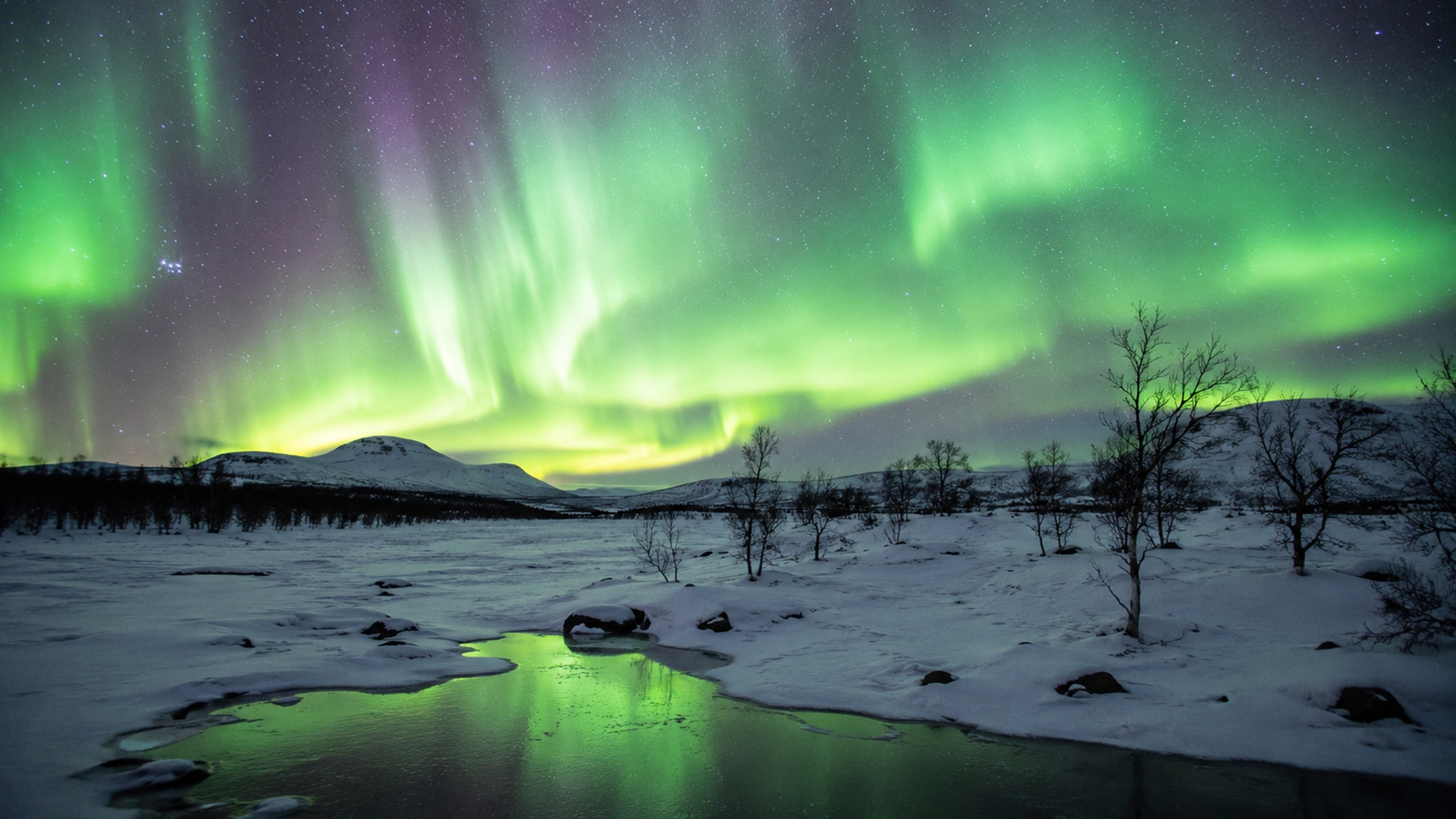
Kiruna is one of the best places in Europe to see the Northern Lights thanks to its Arctic location, long winter darkness and easy access to wilderness areas with very little light pollution.
This guide explains everything you need to know before planning a Northern Lights trip to Kiruna, including the best time to visit, where to see the Aurora, how forecasts work, what to wear, photography tips and whether a guided tour or self-drive adventure is the better choice.
Northern Lights in Kiruna Guide Contents
- What Are the Northern Lights?
- Best Time to See Northern Lights in Kiruna
- Where to See Northern Lights in Kiruna
- Best Aurora Locations by Traveler Type
- Kiruna vs Abisko for Northern Lights
- Lake Torneträsk and Aurora Viewing
- Aurora Sky Station
- Northern Lights Forecast & KP Index
- Weather, Cloud Cover & The Blue Hole
- What to Wear for Aurora Viewing
- Northern Lights Photography Guide
- Self-Drive vs Guided Tours
- Common Mistakes Visitors Make
- Frequently Asked Questions
- Explore Northern Lights Tours in Kiruna
What Are the Northern Lights?
The Northern Lights, also known as the Aurora Borealis, are a natural phenomenon created when charged particles from the sun interact with Earth's atmosphere and magnetic field. These interactions produce moving bands of green, pink, purple and red light that appear across the night sky.
Although Aurora displays occur near both polar regions, Kiruna's location beneath the auroral oval makes it one of the most reliable places in Europe to witness them. Combined with long winter darkness and easy access to dark countryside locations, the region attracts Aurora travelers from around the world every year.
Many visitors assume the Northern Lights only appear during major solar storms. In reality, visible Aurora displays occur frequently throughout the winter season whenever darkness, clear skies and solar activity align.
Many first-time visitors focus entirely on KP forecasts. Local guides often consider cloud cover more important. A weak Aurora under clear skies is usually better than a strong Aurora hidden behind clouds.
The Northern Lights are created when charged particles from the sun collide with gases in Earth's atmosphere. Kiruna's Arctic location beneath the auroral oval makes it one of Europe's best destinations for viewing this natural phenomenon.
Best Time to See Northern Lights in Kiruna
The Northern Lights season in Kiruna generally runs from September until early April. While Aurora activity occurs throughout the year, continuous daylight during summer prevents the lights from being visible.
Most travelers visit between December and March, when long nights provide maximum viewing opportunities. February and March are often considered the best overall months because they combine excellent Aurora potential with more stable weather and slightly more daylight for daytime activities.
| Month | Aurora Potential | Conditions |
|---|---|---|
| September | Good | Early season with milder temperatures |
| October | Very Good | Darker skies and increasing Aurora opportunities |
| November | Very Good | Snow cover arrives and nights become longer |
| December | Excellent | Maximum winter darkness |
| January | Excellent | Very cold but highly active Aurora season |
| February | Excellent | Strong Aurora season with improving weather |
| March | Excellent | Excellent balance of darkness and comfort |
| April | Good | Season gradually comes to an end |
For many travelers, February and March provide the best overall Northern Lights experience. The nights remain dark enough for Aurora viewing, temperatures are often more manageable than in January and daytime conditions are ideal for combining Aurora trips with activities such as dog sledding, snowmobiling and visits to Abisko.
Travelers interested primarily in photography often prefer March because of the longer daylight hours, which allow more time to explore the landscape before heading out for Aurora viewing after dark.
For a complete seasonal breakdown, see our guide Best Time to See Northern Lights in Kiruna.
Where to See Northern Lights in Kiruna
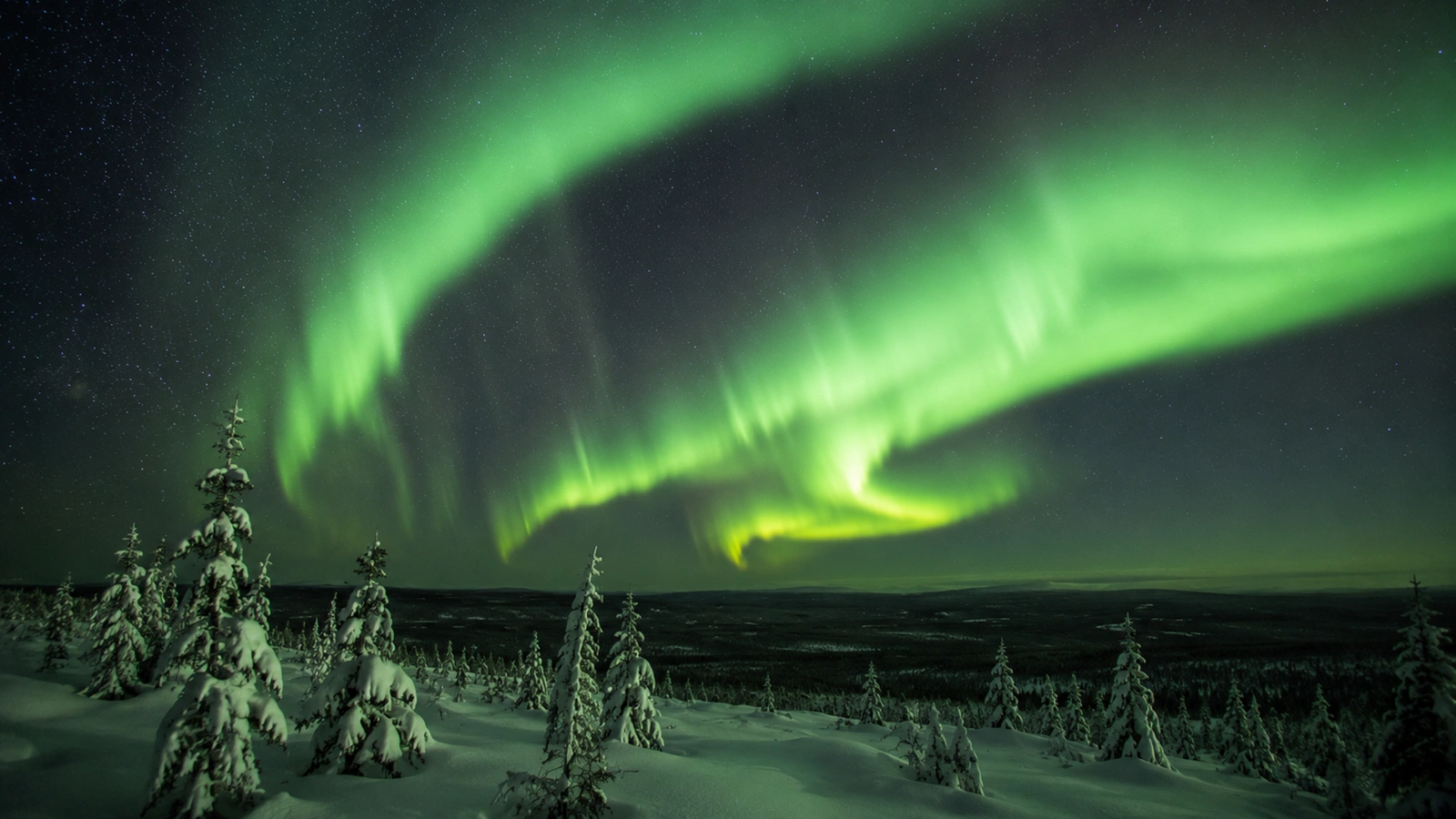
Dark Arctic landscapes around Kiruna provide excellent conditions for Northern Lights viewing away from light pollution.
One of Kiruna's greatest advantages is the variety of Aurora viewing locations available within a relatively short distance. Visitors can choose between mountain landscapes, frozen lakes, forest environments and remote wilderness areas depending on their interests and weather conditions.
Although the Aurora can occasionally be seen from Kiruna city itself, light pollution reduces visibility and makes photography more difficult. Most experienced photographers and guides prefer locations outside the urban area where skies are darker and horizons are more open.
| Location | Distance from Kiruna | Best For |
|---|---|---|
| Abisko | 90 km | Clear skies and Aurora photography |
| Lake Torneträsk | 90 km | Open horizons and reflections |
| Poikkijärvi | 15 km | Dark skies close to Kiruna |
| Jukkasjärvi | 20 km | ICEHOTEL visitors and easy access |
| Nikkaluokta | 60 km | Mountain scenery and wilderness |
| Rautas | 30 km | Quiet and less crowded viewing |
Many travelers choose guided tours because local guides can adapt plans according to cloud cover and road conditions. Rather than staying in one place, guides often move between different locations to find the clearest skies available.
Visitors often assume Abisko is always necessary for seeing the Aurora. In reality, excellent displays are regularly visible around Kiruna itself. The biggest advantage of Abisko is usually the probability of clearer skies rather than stronger Aurora activity.
Best Aurora Locations by Traveler Type
Different Aurora locations suit different types of travelers. Photographers, families, self-drive visitors and first-time Aurora hunters often benefit from different viewing environments.
| Traveler Type | Recommended Location |
|---|---|
| Photographers | Lake Torneträsk or Abisko |
| First-Time Visitors | Guided Aurora Tour from Kiruna |
| Families | Poikkijärvi or Jukkasjärvi |
| Self-Drive Travelers | Rautas and surrounding countryside |
| Travelers Seeking Clear Skies | Abisko |
| Comfort-Oriented Visitors | Glass igloo stays in Poikkijärvi |
The best location ultimately depends on weather conditions. Flexibility often matters more than choosing a single viewing spot before arriving in Swedish Lapland.
Kiruna vs Abisko for Northern Lights
One of the most common questions among Aurora travelers is whether Kiruna or Abisko offers the better Northern Lights experience. Both destinations are excellent, but they serve different travel styles and priorities.
| Factor | Kiruna | Abisko |
|---|---|---|
| Clear Sky Probability | Good | Excellent |
| Light Pollution | Low outside town | Very Low |
| Accommodation Choice | Large selection | Limited selection |
| Winter Activities | Extensive variety | Primarily nature-focused |
| Accessibility | Airport and transport hub | Train connection from Kiruna |
| Aurora Viewing | Excellent | Excellent |
Kiruna works exceptionally well as a base because it offers the region's widest selection of accommodation, restaurants and winter activities. Visitors can combine Northern Lights viewing with dog sledding, snowmobile tours, Sami experiences, the ICEHOTEL and day trips to nearby destinations.
Abisko's strongest advantage is its reputation for clearer skies. The area benefits from a local weather phenomenon known as the Blue Hole, which often creates better viewing conditions than surrounding regions when cloud cover affects other parts of Swedish Lapland.
For travelers with enough time, combining both destinations often provides the best overall Arctic experience.
Kiruna offers more accommodation, activities and transportation options, while Abisko is famous for its higher probability of clear skies. Many travelers combine both destinations to maximize their Northern Lights opportunities.
For a complete comparison, see our guide Kiruna vs Abisko for Northern Lights.
Lake Torneträsk and Why It Matters for Aurora Viewing
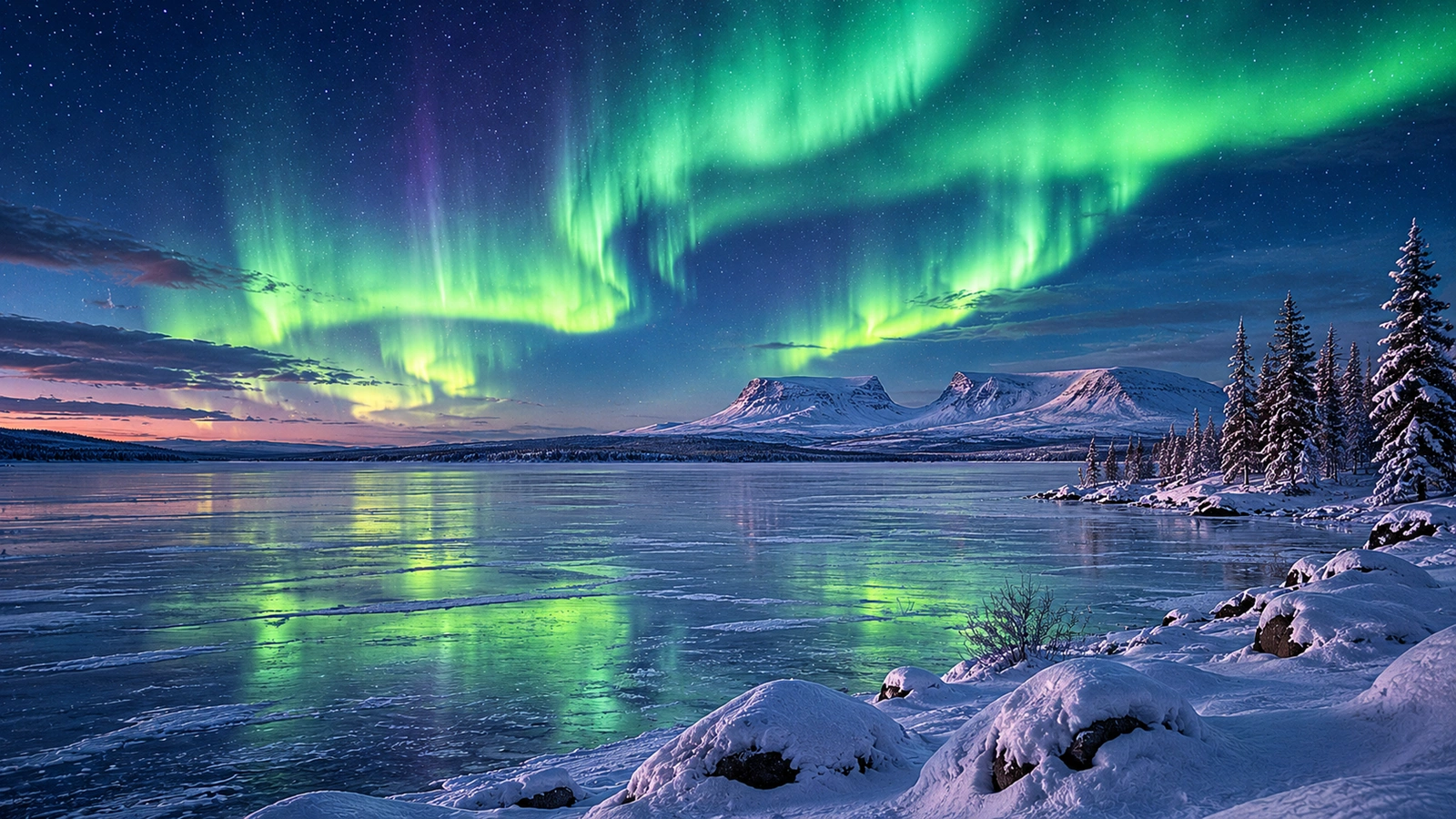
Lake Torneträsk and the iconic Lapporten mountain pass create one of the most photographed Northern Lights landscapes in Swedish Lapland.
Lake Torneträsk is one of Sweden's largest lakes and one of the most iconic landscapes in Swedish Lapland. Located west of Kiruna near Abisko, it has become one of the region's most popular locations for Aurora photography.
The lake offers wide open horizons, very limited light pollution and dramatic mountain scenery. During winter, the frozen surface can create beautiful foregrounds and reflections that enhance Aurora photographs.
Many photographers consider Lake Torneträsk one of the best places in Scandinavia for combining landscape photography with Northern Lights viewing.
| Advantage | Why It Matters |
|---|---|
| Open Horizons | Unobstructed views of the sky |
| Low Light Pollution | Improves Aurora visibility |
| Mountain Scenery | Creates dramatic compositions |
| Frozen Lake Surface | Unique foreground opportunities |
Many of the Northern Lights photographs associated with Abisko actually feature Lake Torneträsk. The lake often provides the foreground, reflections and mountain scenery that make Arctic Aurora images so visually striking.
Learn more in our Lake Torneträsk Guide.
Aurora Sky Station – Is It Worth Visiting?
Aurora Sky Station is one of Sweden's most famous Aurora attractions. Located on Mount Nuolja above Abisko, the station provides elevated views over the surrounding mountains and Lake Torneträsk.
Visitors reach the station via a chairlift journey that climbs high above the valley floor. The experience combines mountain scenery, Aurora viewing opportunities and educational information about the Northern Lights.
For many visitors, the attraction is as much about the Arctic setting and mountain environment as it is about the Aurora itself.
| Best For | Less Suitable For |
|---|---|
| Photographers | Budget travelers |
| Mountain scenery lovers | Visitors sensitive to cold |
| Abisko visitors | Travelers seeking flexibility |
| First-time Aurora travelers | People wanting a mobile Aurora chase |
The station provides a memorable experience, but it is important to understand that no location can guarantee Aurora visibility. Weather and cloud cover always remain important factors.
Read our complete Aurora Sky Station Guide.
Northern Lights Forecast & KP Index
Many Aurora travelers spend considerable time checking forecasts before arriving in Kiruna. While forecasts can be useful, they are often misunderstood.
The most commonly used forecast measurement is the KP index, which estimates geomagnetic activity on a scale from 0 to 9. Higher values generally indicate stronger Aurora activity, but KP alone does not determine whether you will see the Northern Lights.
| KP Index | Aurora Activity | Visibility in Kiruna |
|---|---|---|
| 0–1 | Low | Often visible on clear nights |
| 2–3 | Moderate | Good viewing conditions |
| 4–5 | Strong | Bright and widespread displays |
| 6–7 | Very Strong | Rare and spectacular Aurora events |
| 8–9 | Extreme | Exceptionally rare geomagnetic storms |
One of the biggest mistakes visitors make is assuming a high KP forecast guarantees a successful Aurora experience. In reality, cloud cover is usually a more important factor than solar activity.
A weak Aurora beneath clear skies can often be visible, while a powerful geomagnetic storm hidden behind clouds remains impossible to see.
Many experienced guides pay more attention to weather forecasts than Aurora forecasts. If skies are clear, there is always a possibility of seeing the Northern Lights in Kiruna during the winter season.
For a complete explanation of forecasts, solar activity and Aurora predictions, see our guide Northern Lights Forecast Explained.
Weather, Cloud Cover & the Blue Hole
Weather conditions play a major role in Aurora visibility. While solar activity creates the Aurora, cloud cover determines whether you can actually see it.
This is one reason why Abisko has become so famous among Aurora travelers. The area benefits from the so-called Blue Hole effect, a local weather phenomenon that often results in clearer skies than surrounding regions.
Moist air arriving from the Atlantic loses much of its cloud cover while crossing the Scandinavian mountain range. By the time it reaches Abisko and Lake Torneträsk, conditions are frequently drier and clearer.
| Condition | Impact on Aurora Viewing |
|---|---|
| Clear Sky | Excellent visibility |
| Partial Cloud Cover | Variable visibility |
| Overcast Sky | Aurora not visible |
| Snowfall | Very poor visibility |
Cloud cover is usually more important than KP index. Even strong Aurora activity cannot be seen through clouds, while weak Aurora displays can often be visible on clear nights.
For a deeper explanation of Abisko's weather advantage, read our Abisko Northern Lights Guide.
What to Wear for Aurora Viewing
Aurora viewing often involves standing still outdoors for extended periods in Arctic winter conditions. Proper clothing is therefore one of the most important parts of a successful Northern Lights trip.
Temperatures in Kiruna regularly reach between -10°C and -25°C during the winter season. Wind, humidity and inactivity can make conditions feel even colder.
| Layer | Purpose |
|---|---|
| Base Layer | Moisture management |
| Mid Layer | Insulation and warmth |
| Outer Layer | Protection from wind and snow |
Insulated boots, wool socks, mittens and a warm hat are equally important. Cold feet and hands are among the most common reasons visitors cut Aurora outings short.
- Merino wool base layer
- Insulating mid layer
- Windproof outer jacket
- Insulated winter boots
- Wool socks
- Mittens instead of gloves
- Warm hat and neck protection
- Hand warmers for colder nights
For a complete clothing guide, see The Ultimate Guide to Winter Clothing in Kiruna.
Northern Lights Photography Guide
Photographing the Northern Lights requires preparation, patience and the right equipment. Fortunately, Kiruna offers some of the best Aurora photography opportunities in Europe.
Modern cameras and even newer smartphones are capable of producing impressive Aurora photographs when used correctly. The most important factor is stability, which is why a tripod remains essential.
| Setting | Recommended Starting Point |
|---|---|
| Mode | Manual |
| Aperture | f/1.4–f/2.8 |
| ISO | 800–3200 |
| Shutter Speed | 5–15 seconds |
| Focus | Manual focus on distant objects or stars |
Wide-angle lenses generally work best because they capture both the Aurora and the surrounding landscape. Including foreground elements such as trees, frozen lakes or mountains often produces stronger images than photographing the sky alone.
Kiruna, Lake Torneträsk and Abisko offer some of the most photogenic Aurora landscapes in Scandinavia, combining dramatic Arctic scenery with excellent viewing conditions.
For detailed camera settings and equipment recommendations, see our guide Best Camera Settings for Northern Lights.
Self-Drive vs Guided Tours
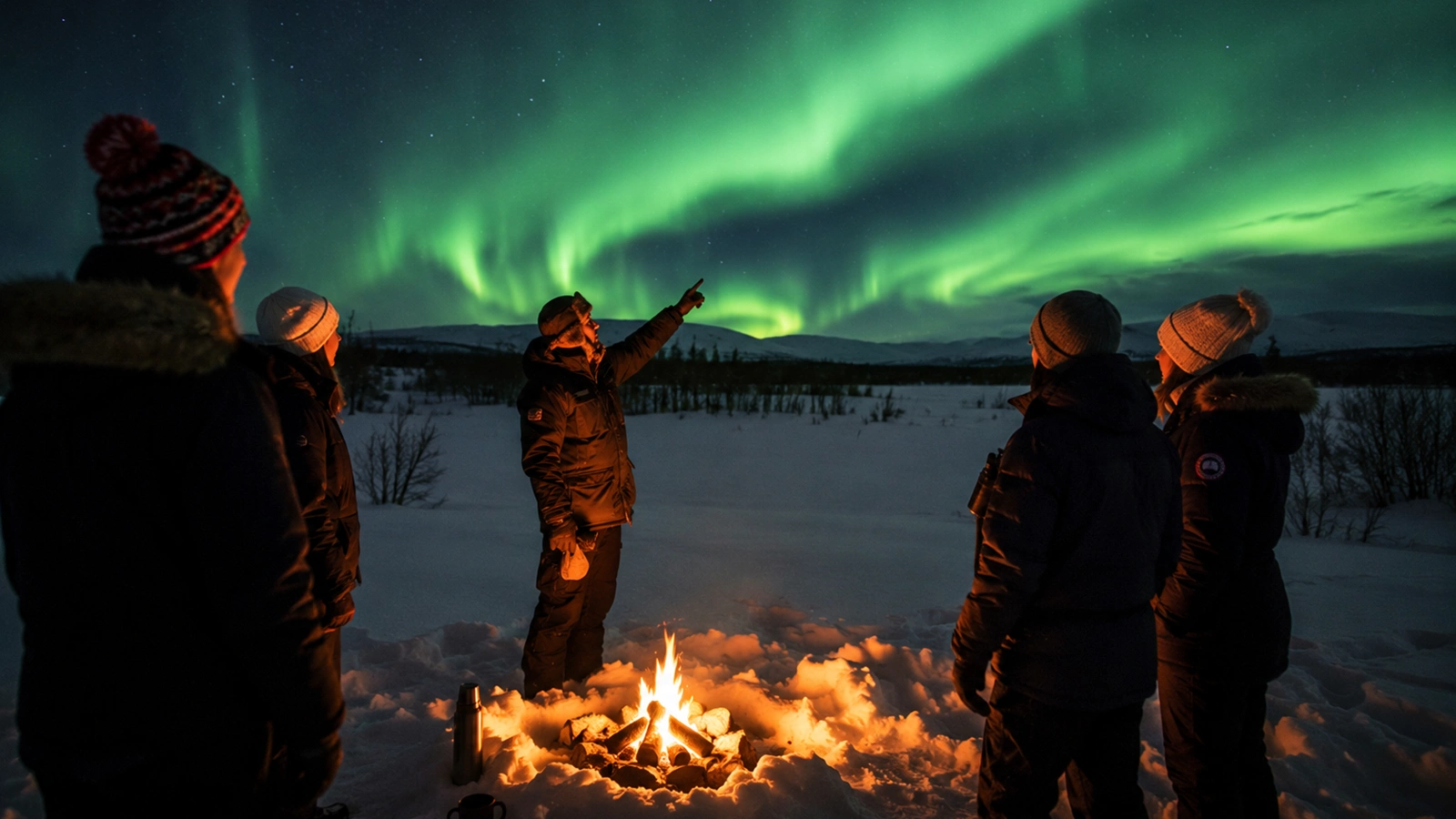
Guided Northern Lights tours allow visitors to reach darker locations and adapt plans according to weather and cloud cover.
Many visitors wonder whether they should search for the Aurora independently or join a guided tour. Both options can work, but they offer very different experiences.
| Self-Drive | Guided Tour |
|---|---|
| Maximum flexibility | Local expertise |
| Lower direct cost | No navigation required |
| Requires winter driving experience | Transportation included |
| Dependent on personal planning | Weather-based route decisions |
| Best for experienced travelers | Best for first-time visitors |
Self-driving provides freedom and flexibility, but winter road conditions can be challenging for visitors unfamiliar with Arctic driving. Snow, ice and limited daylight require caution and preparation.
Guided Aurora tours remove much of the uncertainty. Experienced guides monitor weather forecasts, road conditions and cloud cover while selecting locations that offer the highest chance of successful viewing.
Many first-time visitors assume a fixed viewing location is enough. In reality, experienced guides often drive significant distances during the evening to find clearer skies when weather conditions change.
For many travelers, a guided Aurora tour provides the simplest and most reliable introduction to Northern Lights viewing in Swedish Lapland.
Common Mistakes Visitors Make
Even experienced travelers sometimes misunderstand how Aurora viewing works. Avoiding a few common mistakes can significantly improve your chances of success.
- Expecting the Aurora every night.
- Focusing only on KP forecasts.
- Ignoring cloud cover.
- Underestimating Arctic temperatures.
- Booking only one night.
- Relying entirely on smartphone photography.
- Staying close to city lights.
- Assuming Abisko guarantees Aurora visibility.
The most successful Aurora travelers remain flexible. They monitor weather conditions, stay multiple nights and treat every sighting as a bonus rather than an expectation.
Read more in our guide Common Mistakes Tourists Make in Kiruna.
Planning Your Northern Lights Trip
Kiruna remains one of Europe's premier Aurora destinations, combining Arctic wilderness, long winter darkness and easy access to some of Scandinavia's most famous Northern Lights locations.
Whether you choose to stay in Kiruna, visit Abisko, photograph Lake Torneträsk or experience Aurora Sky Station, the region offers opportunities suitable for first-time visitors, photographers and experienced Arctic travelers alike.
The most successful Northern Lights trips combine realistic expectations, multiple nights, proper winter clothing and flexibility regarding weather conditions. While Aurora sightings can never be guaranteed, Kiruna provides some of the strongest viewing opportunities available anywhere in Europe.