
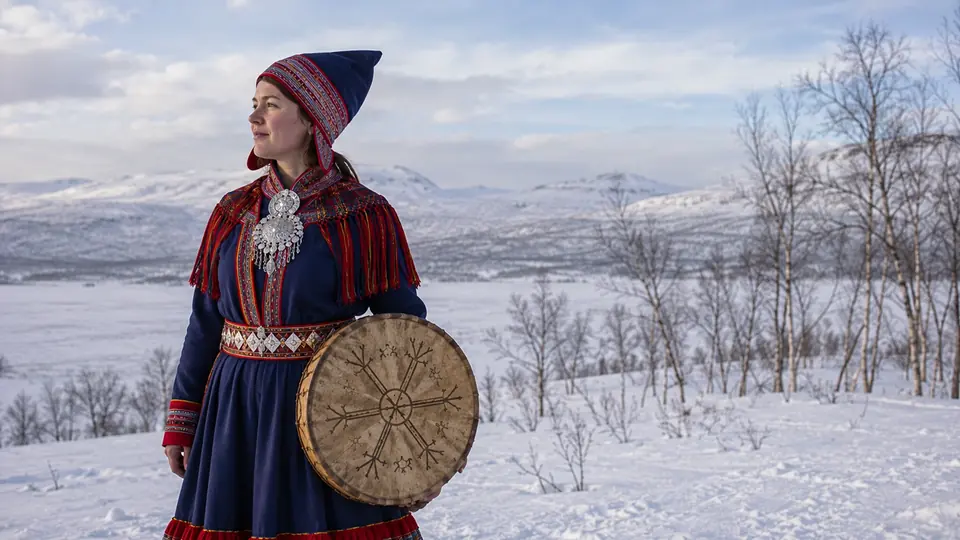
Key Sámi Cultural Terms
Sámi culture is not one uniform set of symbols, clothing styles or customs. Sápmi crosses modern national borders, and traditions vary between regions, languages, families and communities. A useful starting point is to understand a few core terms without assuming that every detail has the same meaning everywhere.
| Term | Practical meaning | Important context |
|---|---|---|
| Sápmi | The traditional homeland of the Sámi people | Extends across parts of northern Sweden, Norway, Finland and the Kola Peninsula in Russia |
| Gákti | Traditional Sámi clothing | Styles and details can reflect regional, local and family traditions |
| Joik | A Sámi vocal tradition | Can be connected with a person, place, animal, memory or feeling |
| Duodji | Traditional Sámi handicraft | Combines practical skill, cultural knowledge, materials and design |
The most useful way to understand Sámi cultural expressions is through context: gákti, joik, duodji, symbols and language are parts of living Sámi cultures, not interchangeable tourist motifs.
Sámi Symbols and Cultural Context
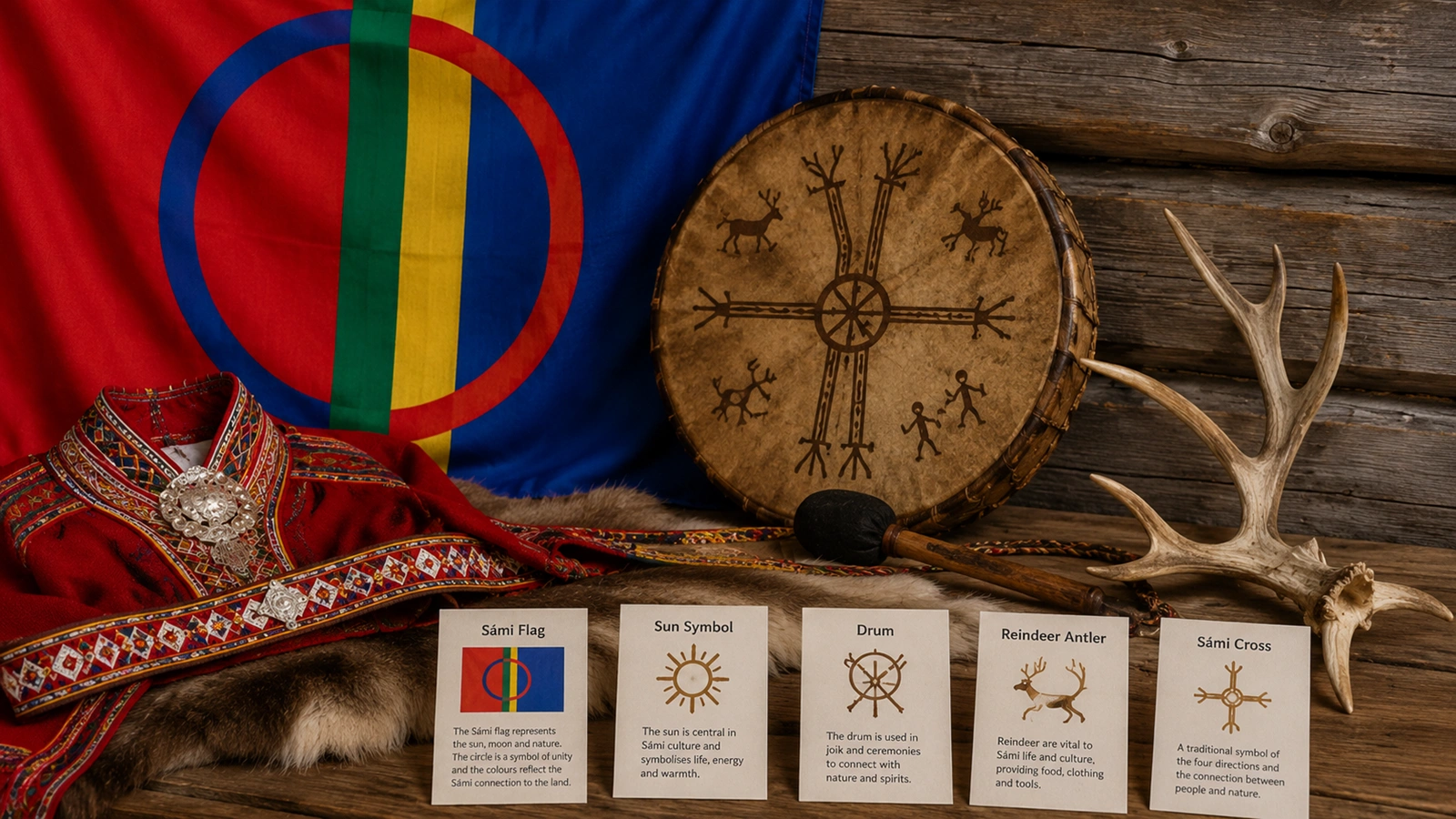
Visitors often search for the meaning of “Sámi symbols,” but there is no single universal symbol dictionary that applies across all of Sápmi. Designs and visual traditions can carry cultural, local, family, spiritual or practical meaning, and interpretation depends on where an object comes from and who made or uses it.
Historically, symbols and decorative elements appeared on objects such as drums, clothing, tools, jewelry and handicrafts. The wider cultural context can include relationships with landscapes, animals, seasonal life, family and community. Treating one motif as if it has one fixed meaning everywhere can oversimplify traditions that developed differently across Sámi regions.
When a symbol, pattern or object matters to your visit, the strongest explanation usually comes from a Sámi guide, maker, cultural institution or other source that can explain its specific regional and cultural context.
For a broader introduction to history, identity and contemporary life, see the Sámi Culture in Swedish Lapland guide.
Gákti: Traditional Sámi Clothing
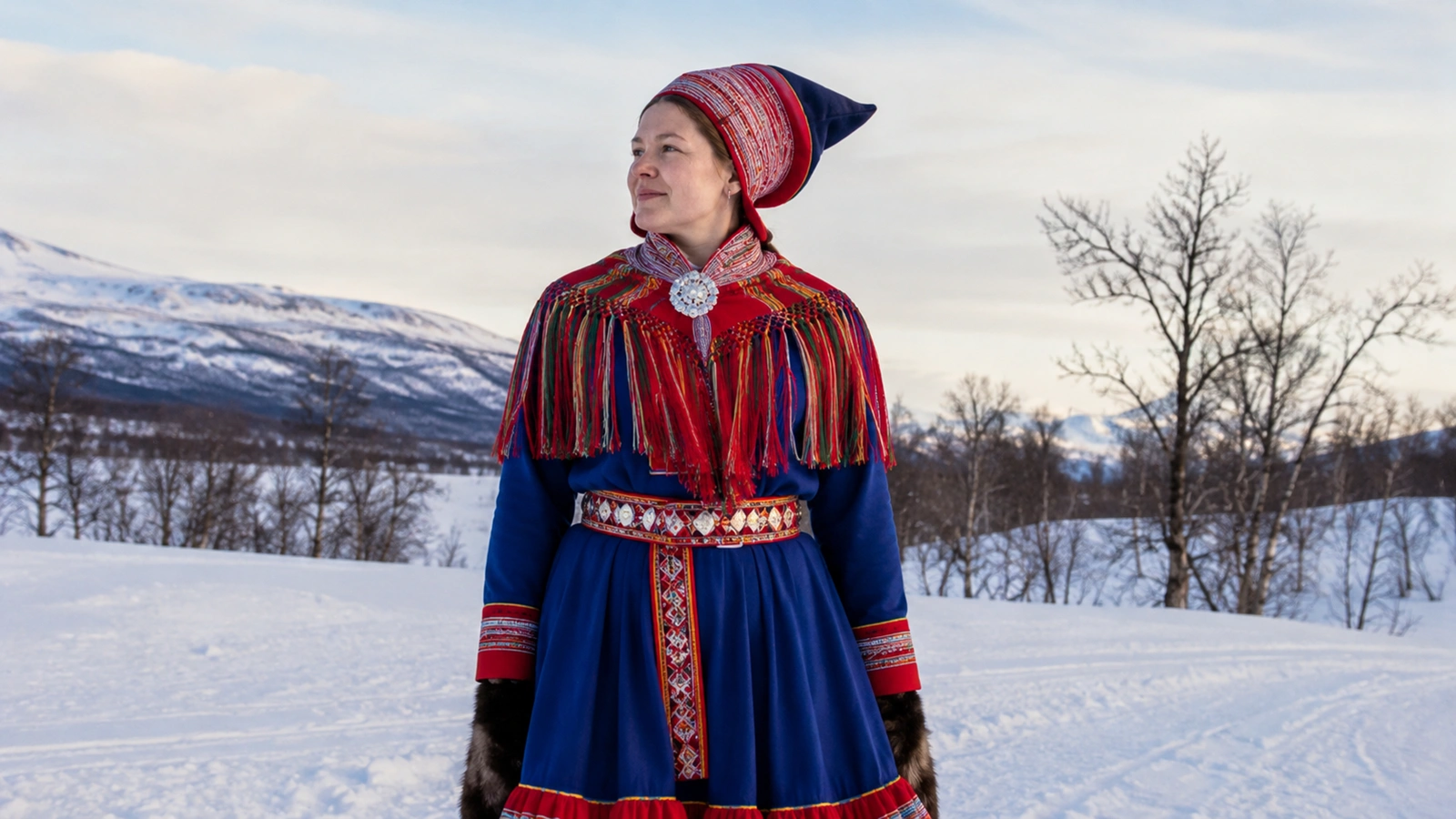
Gákti is traditional Sámi clothing and an important expression of identity and belonging. Different areas of Sápmi have developed distinct styles, and elements such as cut, colors, collars, belts, buttons and other details can reflect local or family traditions.
That does not mean every detail can be decoded by an outsider. The meaning of a particular gákti depends on its cultural context, and it is better to learn from the person wearing it or from knowledgeable Sámi educators than to make assumptions based on color or decoration alone.
Gákti may be worn at celebrations, cultural gatherings, ceremonies and other important occasions. Traditional elements can also be part of contemporary Sámi life rather than something limited to historical displays.
Can Tourists Wear Gákti?
Visitors should not treat gákti as generic Arctic dress-up or a costume. If a Sámi-led cultural experience explains clothing traditions or invites participation in a particular way, follow the guidance of the host. Otherwise, the respectful approach is to learn about the clothing, ask questions appropriately and avoid using culturally specific dress merely as a photo prop.
Gákti is cultural clothing connected with Sámi identity. For visitors, learning what it represents is more appropriate than assuming it is a costume available for anyone to imitate.
Joik: A Living Vocal Tradition
Joik is a long-standing Sámi vocal tradition that remains part of contemporary Sámi culture. A joik can be connected with a person, place, animal, memory or feeling. It is often explained as expressing or evoking its subject rather than simply describing it in the way a conventional song lyric might.
Joik traditions vary across communities and have continued to develop through modern performance as well as cultural transmission. Visitors may encounter joik in Sámi-led experiences, cultural programs and performances where the context of the tradition can be explained alongside the sound itself.

Hearing joik without context can leave a visitor with only the musical surface. Learning who or what a joik relates to, and how the tradition is understood by the performer, gives a more meaningful introduction.
The Sámi Flag
The Sámi flag was adopted in 1986 and is used across Sápmi as a visible symbol of Sámi identity. It uses red, blue, green and yellow, colors that are also widely associated with Sámi cultural expression.
The central circular design is commonly interpreted through sun and moon symbolism, with the red part associated with the sun and the blue part with the moon. The flag is used at cultural celebrations, events and institutions and represents contemporary Sámi identity as well as cultural continuity.
Duodji: Handicraft and Knowledge
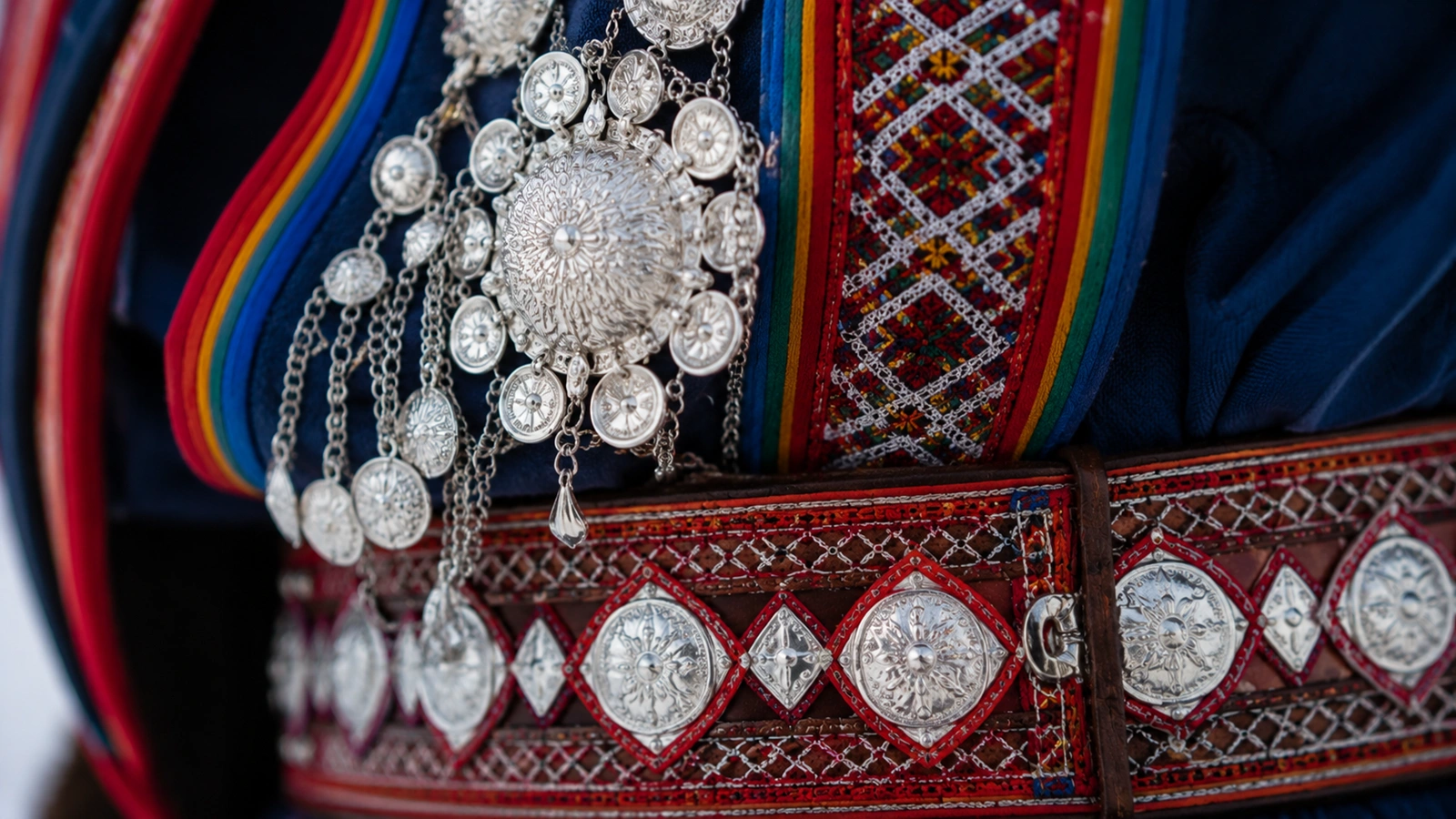
Duodji is traditional Sámi handicraft, but the word describes more than decorative objects. It includes practical skill, material knowledge, design traditions and cultural knowledge passed between generations.
Historically, duodji has included clothing, knives, wooden cups, belts, bags, jewelry and other useful objects. Materials described in Sámi craft traditions include wood, leather, reindeer antler, bone, wool and silver.
Buying Sámi Handicrafts Respectfully
If you want to buy handicrafts, ask who made the item, what materials were used and how the seller describes its cultural origin. This helps distinguish Sámi-made work and culturally grounded craft from mass-produced souvenirs that only imitate a northern visual style.
- Ask about the maker: Who made the item and where are they from?
- Ask about materials: Understand what the object is made from and how it was produced.
- Ask about context: Let the maker or seller explain the design rather than guessing its meaning.
- Avoid imitation: Be cautious with mass-produced products marketed as traditional Sámi craft without clear maker information.
Sámi Languages and Modern Life
There is no single Sámi language. Several distinct Sámi languages are spoken across Sápmi, and Northern Sámi is the language visitors are most likely to encounter in the Kiruna region. Other Sámi languages have their own geographic and community contexts.
Language is part of contemporary Sámi identity as well as cultural heritage. Historical assimilation policies contributed to language decline in some communities, while revitalization efforts today support teaching, public use and cultural continuity.
Sámi life today is diverse. Reindeer herding remains culturally important, but Sámi people also work across education, arts, music, business, politics, research, healthcare, tourism and many other fields. Understanding modern Sámi society means avoiding the idea that Sámi identity belongs only to reindeer herding or to the past.
| Common assumption | More accurate understanding |
|---|---|
| Sámi culture is mainly historical | Sámi cultures are living and continue to change in the present |
| All Sámi people are reindeer herders | Reindeer herding is important, but modern Sámi life includes many livelihoods |
| There is one Sámi language | Several distinct Sámi languages are spoken across Sápmi |
| Traditional clothing is simply decorative | Gákti can carry identity, local and family significance |
How to Experience Sámi Culture Respectfully
For travelers in Swedish Lapland, the strongest cultural experiences are those that provide context and make space for Sámi perspectives. Sámi-led experiences, museums, cultural centers, educational programs and direct engagement with Sámi makers can help visitors understand both heritage and contemporary life.
- Choose context over spectacle: Prefer experiences that explain people, history and present-day culture rather than reducing traditions to entertainment.
- Follow the host's guidance: Cultural practices differ, so let Sámi guides or educators explain what participation is appropriate.
- Ask before close photographs: Treat people as people, not as visual attractions.
- Respect gákti: Do not treat traditional clothing as a costume.
- Support makers: Ask about the origin and maker of handicrafts before buying.
- Remember the present: Learn about modern Sámi life as well as historical traditions.
Reindeer, food, clothing, joik and handicraft can all be meaningful entry points, but none of them represents the whole of Sámi culture on its own. A respectful visit connects these experiences with the people, communities and living traditions behind them.
Common Misunderstandings
| Misunderstanding | Better way to think about it |
|---|---|
| Every Sámi symbol has one universal meaning | Meanings can depend on region, object, maker and cultural context |
| Gákti is a costume | It is culturally significant clothing connected with identity and belonging |
| Joik is simply a type of folk song | It is a distinct Sámi vocal tradition with its own cultural ways of relating to subjects |
| Duodji means any souvenir with a northern pattern | Duodji refers to Sámi craft traditions, knowledge and making |
| Sámi culture can be understood only through reindeer herding | Reindeer herding is important, but Sámi society is broader and diverse |
| Traditional culture and modern life are opposites | Contemporary Sámi life can include both inherited traditions and modern professions and arts |
Cultural etiquette is contextual. If you are unsure whether photography, clothing, participation or interpretation is appropriate, ask the Sámi host, guide, maker or institution rather than relying on a general rule.
What Visitors Should Take Away
Gákti, joik, duodji, the Sámi flag and other cultural symbols are most useful to travelers when they are understood as parts of living Sámi cultures rather than isolated attractions. Their meaning comes from people, place, community and context.
For a visitor to Kiruna or elsewhere in Swedish Lapland, the practical rule is simple: learn before interpreting, listen before assuming and prioritize Sámi-led or culturally grounded explanations whenever possible. That approach gives a more accurate understanding of Sápmi and avoids reducing Indigenous culture to clothing, music or souvenirs alone.