What Is Sámi Food?
Sámi food traditions are closely connected to the landscapes, seasons and ways of life across Sápmi. Reindeer is one of the best-known ingredients, but northern food traditions also include fish, berries, bread and preserved foods. Smoking, drying and cooking over fire are recurring methods associated with food prepared for life in Arctic conditions.
There is no single menu that represents every Sámi family, region or cultural experience. Around Kiruna, visitors may encounter reindeer, Arctic char, lingonberries, cloudberries and flatbread, but what is served depends on the host and the individual experience.
Short answer: Sámi food is not one fixed menu. It reflects regional traditions, seasonal ingredients and the relationship between people, reindeer and the northern landscape.
What Is Sámi Culture in Swedish Lapland?
The Sámi are the Indigenous people of Sápmi, a cultural region extending across northern Sweden, Norway, Finland and parts of Russia. Sámi culture includes different languages, regional traditions, handicrafts, music, storytelling, relationships with the land and, for some families, reindeer herding.
Sámi culture is living contemporary culture, not simply a historical attraction. In and around Kiruna, visitors may encounter cultural elements through food, handicrafts, storytelling, reindeer activities and hosted experiences. The cultural depth varies between activities, so the tour description and the identity of the host matter.
Planning insight: If cultural learning is your priority, look for an experience that clearly identifies who hosts the cultural interpretation and what guests will learn, rather than assuming every reindeer activity is a Sámi cultural tour.
Why Are Reindeer Important in Sámi Culture?
Reindeer have long been important to many Sámi communities for food, hides, materials, transport and reindeer herding. Herding is connected to seasonal movement and detailed knowledge of land and weather, while conditions such as snow, ice and access to grazing areas affect the animals and their care.
Reindeer are culturally important, but Sámi culture is much broader than reindeer herding. Not all Sámi people are reindeer herders, and a visitor should not treat the two terms as interchangeable.
Traditional Sámi Foods You May Encounter
| Food | What It Is | How You May Encounter It |
|---|---|---|
| Suovas | Lightly smoked reindeer meat | Cultural meals and fire-cooked experiences |
| Reindeer stew | Warm reindeer-based stew | Winter meals and longer experiences |
| Gáhkku | Sámi-style flatbread | Meals and gatherings around the fire |
| Arctic char | Northern freshwater fish | Regional meals and restaurants |
| Lingonberries | Tart northern berries | Sauces, drinks and accompaniments |
| Cloudberries | Golden northern berries | Desserts and preserves |
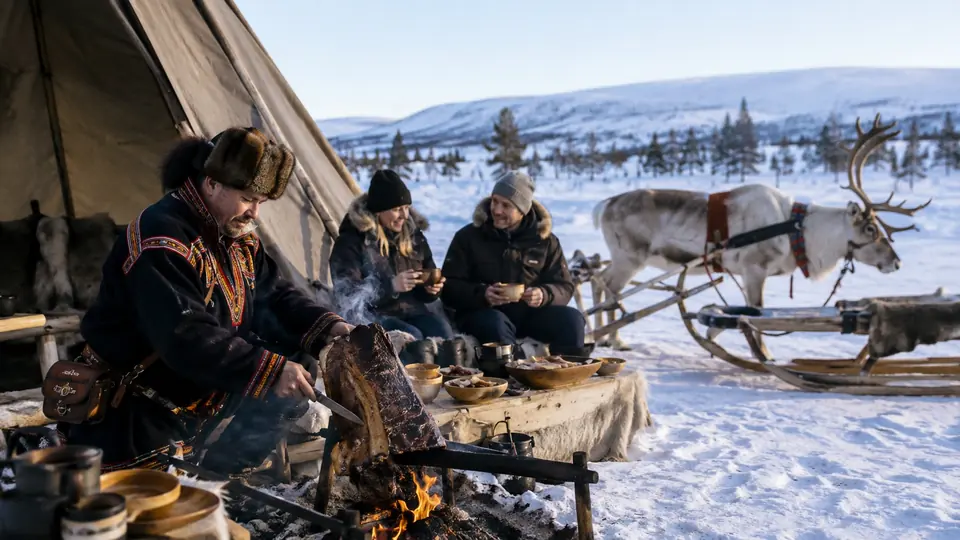
Suovas is one of the foods strongly associated with Sámi culinary traditions. It is lightly smoked reindeer meat and may be served with simple northern accompaniments. Menus differ, so check the actual meal description if tasting a particular food is important to you.
Modern Arctic meals can combine Sámi-inspired ingredients with broader Swedish Lapland or Nordic traditions. A meal described as Sámi-inspired should not automatically be understood as a Sámi-hosted cultural experience.
What Is Reindeer Sledding Like in Kiruna?
Reindeer sledding is a slow, peaceful winter activity. Guests normally sit in a sled while a trained reindeer moves through a snowy area or winter trail. The attraction is not speed: it is the quiet pace, winter landscape and time close to the animals.
The sled ride may be only one part of a longer programme. Depending on the operator, an experience can also include meeting or feeding reindeer, learning about the animals, warming up by a fire, hot drinks, food or cultural storytelling.
A reindeer experience may include
- Meeting reindeer at close range.
- Learning about their behaviour and seasonal life.
- Feeding reindeer when the operator permits it.
- A calm sled ride through snow.
- Time outdoors in the Arctic landscape.
- Warming up beside a fire.
- Hot drinks or a simple meal.
- Information about Sámi culture and reindeer herding when cultural interpretation is part of the programme.
What Is a Lávvu Experience?
A lávvu is a traditional Sámi tent associated with mobility and life in Sápmi. Some modern cultural and food experiences use a lávvu or lávvu-style setting for gathering around a central fire, eating, talking and warming up after time outdoors.
The setting alone does not define the cultural depth of an activity. If learning about Sámi culture matters to you, check who hosts the experience and what cultural interpretation is actually included.
When Is the Best Time for Reindeer Sledding in Kiruna?
December to March is generally the best period for visitors specifically seeking snowy reindeer sledding in Kiruna. Exact operating dates depend on the provider, snow conditions and weather.
| Period | Reindeer Sledding | Food & Cultural Experiences | General Character |
|---|---|---|---|
| December | Usually excellent | Excellent | Deep winter and very short daylight |
| January | Excellent | Excellent | Cold, snowy winter conditions |
| February | Excellent | Excellent | More daylight with full winter conditions |
| March | Excellent | Excellent | Longer daylight and winter snow |
| April | Depends on snow and operator | Often possible | Spring snow and much longer daylight |
| May–August | No snow sledding | Operator dependent | Summer and Midnight Sun season |
| September–November | Usually limited before reliable snow | Operator dependent | Autumn transition toward winter |
For winter preparation, see what to wear in Swedish Lapland.
Which Sámi or Reindeer Experience Should You Choose?
| Your Priority | Experience to Look For | What to Check |
|---|---|---|
| Meet reindeer | Reindeer feeding or enclosure visit | How much time is spent with the animals |
| Try sledding | Dedicated winter reindeer sledding | Ride length and the rest of the programme |
| Learn about Sámi culture | Sámi-hosted cultural experience | Who hosts and interprets the cultural content |
| Try Arctic food | Food experience around the fire | Whether food is traditional, local or Sámi-inspired |
| Combine with aurora viewing | Evening reindeer or food experience | What the tour includes beyond aurora searching |
| Visit with children | Short reindeer visit | Minimum age, duration and cold-weather guidance |
The key distinction is purpose. Choose a reindeer-focused activity when animals and sledding are the priority. Choose a Sámi-hosted experience when direct cultural learning is the priority. Choose a Sámi-inspired food experience when the main interest is northern flavours, fire and winter atmosphere.
How Do You Choose a Respectful Sámi Cultural Experience?
Not every activity involving reindeer is a Sámi cultural experience, and not every Arctic meal is traditional Sámi food. Read the description carefully and look for precise language about the host, cultural content and food.
Useful signs to look for
- The operator explains who is hosting the experience.
- Sámi culture is presented as living and contemporary.
- The programme includes cultural context rather than only photo opportunities.
- Reindeer are handled calmly and respectfully.
- Guests receive guidance about appropriate photography when relevant.
- The description distinguishes Sámi traditions from broader Arctic or Nordic traditions.
- Food is accurately described as traditional, local or inspired rather than overstated.
- There is space for questions when cultural learning is part of the experience.
Sámi-inspired and Sámi-hosted are not the same. A meal can use northern ingredients or draw inspiration from Sámi food traditions without being a Sámi cultural experience. If authenticity and cultural learning are your main reasons for booking, look specifically for information about the host and the cultural interpretation.
What Should You Expect During a Winter Reindeer Experience?
Reindeer activities are generally calm rather than physically demanding, but winter conditions can make them feel more demanding than expected because guests may spend long periods standing or sitting outdoors.
- Much of the experience may take place outdoors.
- Temperatures well below freezing are possible.
- Sled rides may be shorter than travelers initially expect.
- The cultural component can be more important than the ride itself.
- Hot drinks or food may be served around a fire.
- Some operators provide thermal clothing.
- Weather and animal welfare can affect the programme.
What Should You Wear and Bring?
Dress for standing still outdoors, not only for walking. Sitting in a sled or listening to a guide produces much less body heat than active movement.
| Item | Why It Matters |
|---|---|
| Thermal base layer | Provides insulation close to the body |
| Warm mid-layer | Helps trap heat beneath outer clothing |
| Insulated outer clothing | Protects against cold and wind |
| Wool socks and insulated boots | Important when standing or sitting on snow |
| Mittens | Help protect hands during inactive periods |
| Warm hat and neck protection | Protect exposed areas |
| Camera or phone | Useful for reindeer and winter landscapes |
| Spare battery | Cold weather reduces battery performance |
Some tour companies provide thermal overalls, boots or other winter equipment. Check exactly what your chosen operator includes before arriving.
What Can You Combine With a Reindeer Experience?
Because reindeer activities are generally calm and require no previous experience, they can fit easily into a broader Kiruna winter itinerary.
| Combination | Why Travelers Choose It |
|---|---|
| Reindeer + Northern Lights | Combines a reindeer experience with an Arctic evening |
| Reindeer + ICEHOTEL | Pairs two different Kiruna-area winter experiences |
| Reindeer + dog sledding | Contrasts a slow reindeer activity with another animal-based winter experience |
| Reindeer + snowmobile | Balances a peaceful activity with a faster winter activity |
| Arctic food + aurora evening | Combines food, fire and time outdoors after dark |
For broader planning, continue with things to do in Kiruna, the Jukkasjärvi Sámi culture guide or the guide to respectful Sámi culture experiences.