Short Answer Summary
You do not need a luxury camera to photograph the Northern Lights. A modest camera or recent phone can work if it is stable, protected from cold and used correctly. Spend first on a tripod, spare batteries, warm clothing and a basic wide-angle setup.
Best Arctic Photography Setup by Budget
- Best beginner setup: mirrorless or DSLR with kit lens, tripod and spare batteries.
- Best phone setup: recent smartphone plus small tripod and night mode.
- Best lens type: wide-angle lens with f/2.8 or wider aperture.
- Most important accessory: stable tripod.
- Most common failure: dead batteries and soft focus.
- Best Arctic photography months: February and March.
- Main weather risk: cloud cover and condensation.
What Actually Matters for Arctic Photography?
The Arctic exposes weak planning fast. Cameras can work well in cold weather, but the person using them often becomes the limiting factor: cold fingers, dead batteries, fogged lenses, unstable tripods and poor focusing cause more failed photos than camera quality.
For Northern Lights photography, your priority order should be stability, battery warmth, lens brightness, manual control and personal comfort. A good aurora image is usually made by standing in the right dark place with a stable setup, not by owning the newest camera body.
The best Arctic photography investment is usually not a new camera body. It is a tripod, spare batteries, warm hands and enough patience to stay outside when conditions become good.
| Gear Decision | Priority | Why It Matters | Best First Step |
|---|---|---|---|
| Tripod | Very high | Long exposures fail if the camera moves. | Use a stable tripod with a secure head. |
| Batteries | Very high | Cold reduces battery performance quickly. | Carry warm spares inside your jacket. |
| Lens | High | A wide bright lens gathers more sky and light. | Use 14–24mm full-frame equivalent if possible. |
| Camera body | Medium | Modern bodies help, but they are not the whole answer. | Use manual mode and RAW before upgrading. |
| Clothing | Very high | You cannot adjust settings well if your hands are freezing. | Use liner gloves plus warm mittens. |
What Gear Is Essential for Northern Lights Photography?
A Sturdy Tripod
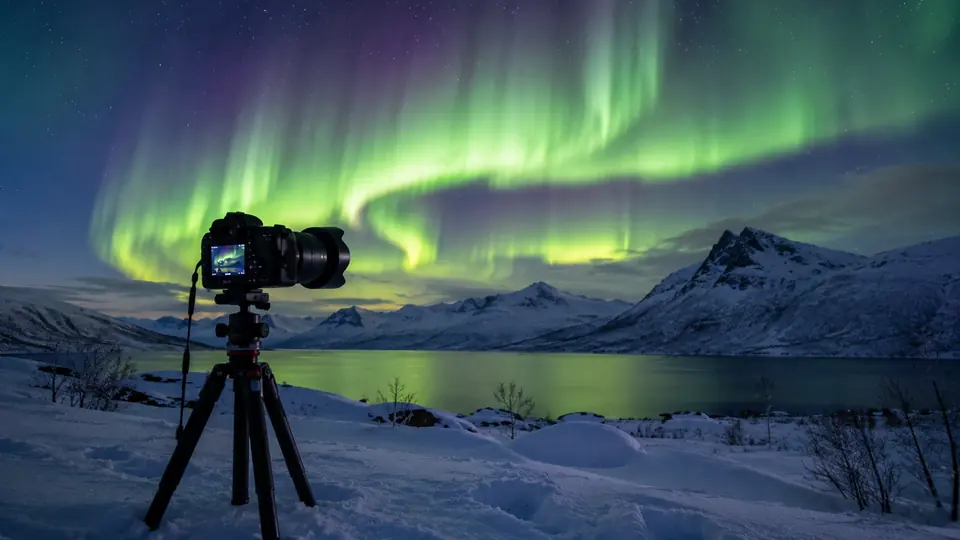
Aurora photography uses long exposures, often several seconds. That means even tiny movement can ruin the image. A light travel tripod may work in calm weather but often becomes unstable in Arctic wind or snow.
Choose a tripod that is stable enough for winter conditions and simple to operate with gloves. Avoid relying heavily on extended center columns because they reduce stability significantly.
Extra Batteries Kept Warm
Cold drains batteries dramatically faster than normal conditions. Keep spare batteries inside an inner pocket close to your body and rotate them regularly during long sessions.
For a winter evening in Kiruna or Abisko, three fully charged batteries is often a realistic minimum for mirrorless users.
A Wide-Angle Lens
Northern Lights often cover large areas of sky. Wide lenses allow you to include mountains, cabins, trees, frozen lakes and foreground details instead of photographing only green light.
Fast apertures like f/1.4, f/1.8 or f/2.8 help significantly in dark Arctic conditions, especially during weaker aurora displays.
Manual Camera Control
Manual focus and manual exposure matter more than automatic scene modes. Autofocus frequently struggles in darkness, snowfall or weak aurora conditions.
Learning manual focus before the trip is often more valuable than upgrading equipment.
Reliable Memory Cards
Cheap memory cards create unnecessary risk in cold environments. Use trusted cards with enough capacity for RAW files, time-lapses and video.
Carry at least one backup card because Arctic weather and condensation can increase equipment stress.
Which Photography Gear Is Nice to Have?
Headlamp with Red Light
A red-light headlamp protects night vision and helps avoid disturbing other photographers nearby.
Lens Warmer
Lens warmers help prevent frost during long exposures or time-lapse sessions. They become more useful during humid conditions or coastal weather.
Power Bank
Phones lose battery quickly in Arctic cold. A warm power bank stored inside your jacket can extend shooting time significantly.
What Arctic Photography Gear Should You Skip First?
Ultra-Expensive Camera Bodies
Many visitors buy expensive camera bodies while still lacking tripod stability, spare batteries or warm clothing. That usually produces worse results than a balanced beginner setup.
Heavy Telephoto Lenses
Telephoto lenses are useful for wildlife but not usually for aurora. Northern Lights photography is primarily wide-angle landscape photography.
Can You Photograph Northern Lights with a Phone?
Yes. Modern smartphones can produce surprisingly good aurora photos if they are stable and used correctly. Stability matters more than megapixels.
Use a small tripod, activate night mode, use a timer and avoid touching the phone during exposure. Cold management matters just as much for phones as for cameras.
| Setup | Works for Aurora? | Best Use | Main Limitation |
|---|---|---|---|
| Recent phone + tripod | Yes | Social media and memories. | Limited manual control. |
| Older phone handheld | Usually poor | Strong displays only. | Motion blur and low light. |
| Mirrorless + kit lens | Yes | Beginner aurora photography. | More noise and slower lens. |
| Mirrorless + fast wide lens | Excellent | Best visitor setup. | Higher cost. |
What Are the Best Lenses for Arctic Photography?
Wide-angle lenses dominate Arctic photography because they capture both sky and landscape. Extremely tight compositions rarely communicate the scale of the Arctic environment.
| Lens Type | Best For | Strength | Main Limitation |
|---|---|---|---|
| 14–24mm f/2.8 | Aurora landscapes | Wide sky coverage. | Expensive. |
| 20mm f/1.8 | Fast aurora work | Excellent low-light performance. | Fixed focal length. |
| 24–70mm | General travel photography | Flexible composition. | Less dramatic sky coverage. |
| 70–200mm | Wildlife and mountain compression | Strong daytime landscapes. | Limited aurora use. |
What Camera Settings Should You Start With?
Mode: Manual (M)
File format: RAW
Aperture: f/2.8 or widest available
ISO: 1600–3200
Shutter speed: 5–15 seconds
White balance: 3500–4000K
Focus: Manual focus on a star or distant light
Aurora settings always depend on activity level, moonlight, clouds and lens brightness. Strong fast-moving aurora requires shorter exposures than weak slow-moving displays.
Local Insight: Focus Before the Sky Explodes
Many visitors lose their best aurora moment because they start learning focus after the display begins. Set focus early, confirm sharpness on stars and leave the focus ring untouched.
How Do You Make Aurora Photos Look Better?
Foreground composition matters as much as the aurora itself. Trees, cabins, frozen lakes, mountains, campfires and reflections create stronger Arctic storytelling than photographing only empty sky.
Lapporten, Lake Torneträsk, snowy forest roads and frozen riverbanks are popular because they combine clear northern horizons with recognizable Scandinavian landscape elements.
Strong aurora photos usually combine sky, landscape and scale. The Northern Lights alone are rarely enough to create a memorable Arctic image.
How Do You Protect Camera Gear in Arctic Cold?
Condensation is often more dangerous than the cold itself. When a freezing camera enters a warm room, moisture can form on lenses, sensors and internal surfaces.
Place the camera inside a sealed plastic bag before going indoors and allow it to warm gradually. This reduces sudden condensation exposure.
Cold-Weather Camera Care Checklist
- Keep spare batteries warm inside your jacket.
- Use sealed bags before entering warm rooms.
- Carry multiple dry microfiber cloths.
- Avoid breathing directly on the lens.
- Keep tripods free from packed snow and ice.
- Let equipment warm slowly indoors.
Can You Use Drones in Kiruna and Abisko?
Drone flying in Swedish Lapland is regulated and should never be assumed automatically legal. National parks, protected areas, airports and military-sensitive regions may have restrictions or flight limitations.
Always check current Swedish drone regulations before flying. Weather, wind, battery performance and darkness also make Arctic drone flying more difficult than standard travel conditions.
How Should You Store and Back Up Photos?
Arctic trips often produce large RAW files and time-lapse sequences. Bring enough memory cards and create backups during the trip if possible.
A small SSD, laptop or cloud backup workflow can prevent losing the entire trip because of one failed card.
What Clothing Matters Most for Photographers?
Photographers stand still longer than hikers. Clothing must be designed for inactive cold exposure, not only movement.
- Thin liner gloves for camera controls.
- Warm mittens between adjustments.
- Insulated winter boots.
- Thermal base layers.
- Windproof outer shell.
- Hand warmers for long nights.
- Face protection during wind.
Should You Rent or Buy Photography Gear?
If this is your only Arctic trip, renting lenses can be smarter than buying expensive gear. Batteries, memory cards and winter accessories are usually better purchased directly.
Problem: Visitors Spend Money in the Wrong Order
Many travelers buy expensive camera bodies while ignoring tripods, batteries, condensation control and warm clothing. That creates expensive but unreliable setups.
Solution: Build Around Arctic Failure Points
Prioritize stability, warm batteries, weather protection and personal comfort first. Upgrade lenses before camera bodies if aurora photography is the main goal.
Common Mistakes Visitors Make
- Using autofocus in darkness.
- Carrying only one battery.
- Ignoring condensation risk.
- Using unstable tripods.
- Forgetting gloves that work with camera controls.
- Photographing only sky with no foreground.
- Over-editing aurora colors unrealistically.
- Expecting every night to produce strong aurora.
Realistic Expectations for Aurora Photography
Your camera often sees more color than your eyes because long exposures collect light over time. This is normal and does not automatically mean the image is fake.
Weather, cloud cover, moonlight, wind and patience matter more than internet hype. Some nights produce dramatic displays. Other nights remain weak despite good forecasts.
Final Verdict: What Should You Pack?
Bring a stable tripod, warm spare batteries, a wide lens, microfiber cloths, proper winter gloves and a realistic understanding of Arctic weather. Add a headlamp, phone tripod and lens warmer if you want extra comfort.
Do not let equipment anxiety stop you from going outside. Kiruna and Abisko reward patience, preparation and realistic expectations far more than luxury camera bodies.
Practice Arctic Photography on a Northern Lights Tour
Guided Northern Lights tours help with dark-sky access, weather reading, safety and basic aurora photography settings. Some operators may also offer tripod or camera rental.