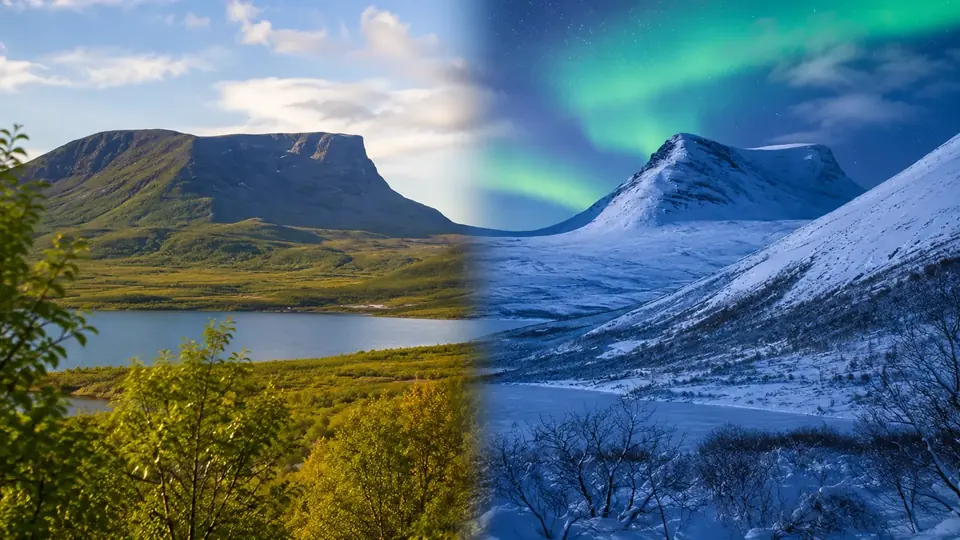
Best Time to Visit Abisko at a Glance
There is no single best month for every Abisko trip. The right time depends on whether your priority is Northern Lights, deep winter scenery, hiking, the Midnight Sun or autumn color.
| Travel Goal | Best Period | Main Trade-off |
|---|---|---|
| First winter trip | February–March | Strong winter conditions with more usable daylight than midwinter |
| Northern Lights | Late August–early April | Darkness is necessary, but cloud cover and aurora activity still vary |
| Hiking | June–September | Trail conditions and weather remain variable in the mountains |
| Midnight Sun | Late May–mid-July | Continuous daylight means no meaningful darkness for aurora viewing |
| Autumn color + early aurora | September | Weather is more transitional than in high summer |
For most first-time winter visitors, February and March are a strong compromise because Abisko still has snow and dark evenings while daylight has returned for daytime activities. Summer travelers should choose dates around the activity they want to do rather than using a winter-focused recommendation.
For the wider destination context, see the Abisko Travel Guide.
Season-by-Season Comparison
Abisko changes dramatically across the year. The most useful way to choose dates is to match the season to the experience you want instead of treating one month as universally superior.
| Period | Best For | What to Expect |
|---|---|---|
| December–January | Deep winter, long darkness, Arctic atmosphere | Very limited daylight, snow and colder conditions |
| February–March | Winter balance, Northern Lights, daytime activities | Dark evenings with steadily increasing daylight |
| April–May | Late snow scenery and seasonal transition | Rapidly increasing daylight and changing activity conditions |
| June–August | Hiking, mountain scenery, Midnight Sun | Very long daylight and no useful darkness for aurora viewing |
| September–October | Autumn scenery and returning darkness | More variable weather and the return of Northern Lights opportunities |
| November | Early winter atmosphere | Transition toward deeper winter, with conditions varying from year to year |
Best Time for Northern Lights in Abisko
Northern Lights viewing requires darkness, so the practical aurora season is roughly from late August to early April. Within that window, December to March is the main winter travel period because it combines dark evenings with established winter conditions.
No month guarantees an aurora display. Visibility depends on both space weather and local cloud cover. That is why travelers should plan for several nights whenever possible rather than treating one evening as decisive.
The most useful planning rule is to separate aurora activity from sky visibility. A strong aurora cannot be seen through thick cloud, while a modest display can still be rewarding under a clear sky.
For more detailed aurora planning, continue to the Abisko Northern Lights Guide.
Why February and March Work Well for First-Time Winter Visitors
February and March are often easier for first-time winter travelers because Abisko still offers snow, dark evenings and strong winter atmosphere, but there is more daylight for national park walks, photography and other daytime activities than in December or early January.
The trade-off is that the atmosphere is no longer the same as the darkest part of winter. Travelers who specifically want the deepest midwinter experience may prefer December or January even though the limited daylight makes daily planning more restrictive.
| February–March Advantage | Why It Matters |
|---|---|
| Dark evenings remain | Northern Lights viewing is still possible |
| More daylight | It is easier to combine daytime scenery with evening aurora plans |
| Established winter conditions | The destination still feels fully Arctic |
| Longer activity window | Daytime and evening experiences are easier to fit into the same trip |
December and January: Deep Winter and Limited Daylight
December and January suit travelers who value deep winter atmosphere and long darkness more than daytime flexibility. This period can feel especially Arctic, but short daylight makes sightseeing and outdoor planning more concentrated.
The limited light is not necessarily a disadvantage if the trip is built around winter scenery and Northern Lights. It becomes a trade-off when you also want long daytime hikes, extensive landscape photography or a packed sightseeing schedule.
- Choose December–January if: deep winter atmosphere and darkness are central to the trip.
- Choose February–March if: you want a more balanced winter itinerary with both daytime and evening experiences.
Best Time for Hiking in Abisko
June to September is the main hiking period in the Abisko region. Summer and early autumn provide the long daylight and mountain access that winter travelers do not have.
July and August are especially useful for travelers whose priority is hiking rather than aurora viewing. September adds autumn color and returning darkness, but conditions become more transitional as the season changes.
Hikers should still plan around mountain weather rather than assuming summer means stable conditions. For trail-focused planning, see the Hiking in Abisko guide and the Abisko National Park Guide.
Midnight Sun Season
Around late May to mid-July, Abisko experiences the Midnight Sun period, when daylight remains around the clock. This is a major advantage for hiking, photography and flexible outdoor schedules.
The same continuous daylight makes this the wrong season for travelers whose main goal is seeing the Northern Lights. Summer and aurora trips should therefore be treated as different types of Abisko visit rather than combined into one expectation.
Choose the Midnight Sun period for long daylight and mountain exploration, not for aurora viewing.
September: Autumn Color and Early Aurora Opportunities
September is a useful crossover month for travelers who want both autumn landscapes and the return of dark nights. Hiking may still be part of the trip, while Northern Lights viewing becomes possible again once darkness returns.
The compromise is greater weather variability. Travelers choosing September should keep plans flexible and treat the combination of hiking, autumn color and aurora as an opportunity rather than a guarantee that every element will align perfectly.
Lake and mountain scenery are central to this season, so the Lake Torneträsk Guide is useful for understanding the surrounding landscape.
Spring and Early Winter Transitions
April, May and November are transition periods. They can still be rewarding, but they require more careful expectation-setting because snow, daylight and activity conditions can change quickly around the edges of the main winter and summer seasons.
April brings rapidly increasing daylight and the end of the practical aurora season. May sits between winter and summer travel. November moves in the opposite direction as darkness and winter conditions return.
These months can work well for travelers who are flexible, but they are less straightforward than February–March for a first winter trip or July–August for a hiking-focused summer trip.
What the Blue Hole Means for Planning
Abisko is known for the so-called Blue Hole, a local clear-sky effect associated with the surrounding mountain geography and Lake Torneträsk. It can sometimes leave Abisko with clearer conditions than nearby areas.
The Blue Hole is an advantage, not a guarantee. Cloud cover can still block the sky, and clear weather does not guarantee aurora activity. Travelers should therefore use Abisko's weather reputation as one factor in planning rather than as a promise of Northern Lights.
How to Choose Your Abisko Travel Dates
Start with the experience you would be most disappointed to miss, then choose the season around that priority.
| If Your Priority Is... | Choose... | Avoid Expecting... |
|---|---|---|
| Northern Lights + winter activities | February–March | Guaranteed aurora or mild weather |
| Deep Arctic darkness | December–January | Long daytime sightseeing hours |
| Hiking and national park exploration | June–September | Summer aurora viewing |
| Midnight Sun | Late May–mid-July | Dark nights |
| Autumn color + early aurora chance | September | Stable high-summer conditions |
Once the season is chosen, accommodation and transport become the next constraints. The Where to Stay in Abisko guide helps match the location of your stay to the type of trip you are planning.