Short Answer Summary
Choose Abisko if your main priority is Northern Lights visibility, quiet dark-sky viewing and aurora photography. Choose Kiruna if you need airport access, more restaurants, broader accommodation choice and more guided winter activities. The strongest Swedish Lapland itinerary often combines both.
Why Abisko Is Famous for Northern Lights
Abisko is famous because it combines high northern latitude, winter darkness, low light pollution, mountain scenery and a local reputation for clearer skies. The aurora is not automatically stronger above Abisko every night. The practical advantage is that visitors may have a better chance of seeing open sky when aurora activity is present.
Abisko sits beside Lake Torneträsk and close to Abisko National Park in Kiruna Municipality. The lake and surrounding mountains influence local weather, which is why aurora travelers often treat Abisko as a specialist destination rather than a general winter resort.
Abisko’s real advantage is probability: darkness, open landscapes and a local clear-sky reputation. It is not a guarantee of visible Northern Lights.
What Is the Abisko Blue Hole?
The Abisko Blue Hole is the common travel term for the local tendency toward clearer skies around Abisko compared with nearby mountain and coastal areas. It is linked to the geography around Lake Torneträsk and the surrounding mountains.
Travelers should understand the term correctly. The Blue Hole can improve the odds, but it does not remove cloud risk. There can still be full overcast nights, snowfall, wind and poor visibility.
Local Insight: Do Not Treat the Blue Hole as a Promise
Many visitors hear “Blue Hole” and assume Abisko guarantees aurora. A better way to plan is to treat Abisko as a higher-probability location. Stay more than one night, follow cloud forecasts and be prepared to wait outdoors.
Best Months to See Northern Lights in Abisko
The aurora season normally runs from late August or September until late March or early April, depending on darkness. For most winter visitors, January to March gives the best balance of darkness, snow cover and practical daylight for daytime activities.
| Month | Aurora Conditions | Landscape | Best For |
|---|---|---|---|
| September | Good early-season darkness. | Autumn colors, little or no snow. | Travelers wanting milder nights. |
| October | Good to very good. | Darker nights, early snow possible. | Lower-crowd aurora travel. |
| November | Very good if skies clear. | Early winter; snow depth varies. | Quiet shoulder season. |
| December | Excellent darkness. | Deep winter atmosphere. | Visitors comfortable with short daylight. |
| January | Excellent. | Cold, dark and snowy. | Dedicated aurora travelers. |
| February | Excellent. | Snowy with more daylight. | Best balance for many visitors. |
| March | Excellent evenings. | Longer days and dark nights. | Photography and easier winter travel. |
Best Time to Visit Abisko for Northern Lights
January to March is usually the strongest period because dark evenings combine with snow-covered landscapes and more stable winter travel conditions. February and March often give the best overall balance for first-time visitors.
Northern Lights Forecast Reality: Clear Sky Beats KP Obsession
Many first-time visitors focus too much on KP index. KP can indicate geomagnetic activity, but it is not enough. In Abisko, a moderate aurora under clear sky is often more useful than a high KP forecast hidden behind cloud.
| Situation | Practical Result | Reason |
|---|---|---|
| High KP + heavy cloud | Low viewing chance | Aurora can happen above the clouds without being visible. |
| Moderate KP + clear sky | Good viewing chance | Clear local sky often matters more than a high number. |
| Low KP + clear dark sky | Possible faint aurora | Weak displays can still be visible at high latitude. |
| Partial cloud + active aurora | Variable | Openings in cloud can create short strong moments. |
Abisko Aurora Success Checklist
- Check cloud cover before focusing on KP index.
- Stay at least two nights if aurora is the main goal.
- Choose dark areas away from the strongest lights.
- Dress for standing still in cold weather.
- Use a tripod or stable support for photography.
- Use Kiruna as the logistics base if flight times and services matter.
Best Places to See Northern Lights in Abisko
Abisko National Park
Abisko National Park is the classic aurora setting. It offers dark surroundings, mountain silhouettes and access to open areas away from strong artificial light.
Lake Torneträsk
Lake Torneträsk gives wide horizons and strong landscape compositions. Conditions on and near frozen water require caution, so visitors should avoid unsafe ice and follow local advice.
Aurora Sky Station Area
The Aurora Sky Station area is one of the best-known aurora locations in Sweden. Access depends on season, weather, wind and operational conditions, so it should not be treated as the only viewing plan.
Dark Areas Outside Abisko Village
Moving away from the brightest accommodation and road lights can improve visibility. You do not always need to travel far, but winter safety still matters in cold, wind and low visibility.
| Location | Best For | Difficulty | Photography Strength |
|---|---|---|---|
| Abisko National Park | Classic dark-sky viewing | Easy to moderate | Excellent |
| Lake Torneträsk | Wide sky and lake horizon | Moderate | Excellent |
| Aurora Sky Station area | Elevated views when operating | Moderate | Very strong |
| Village outskirts | Simple viewing near accommodation | Easy | Good |
Lapporten and Arctic Scenery Around Abisko
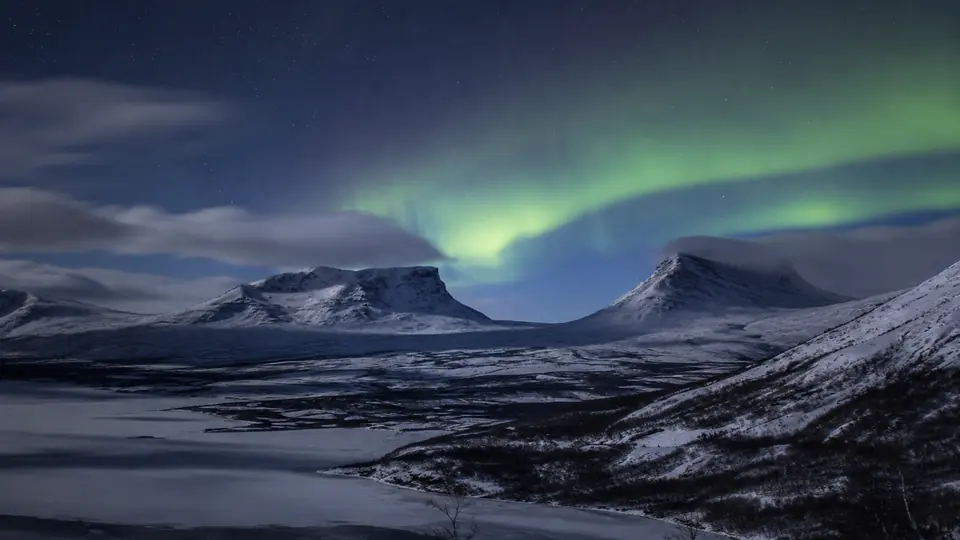
Lapporten is one of the most recognizable mountain formations in Swedish Lapland and has become a visual symbol of the Abisko region. The large U-shaped valley between the mountains is especially dramatic during winter nights with snow and aurora overhead.
For photographers, Lapporten helps create a stronger sense of Arctic scale compared with forest-only aurora locations. The combination of mountains, open sky and snow-covered landscape is one reason Abisko feels different from many other Northern Lights destinations.
Local Insight: Arctic Scale Is Bigger Than It Looks
Many visitors underestimate the size of the landscape around Abisko. Mountains and valleys that appear close in photos can still require significant hiking time and winter awareness to reach safely.
Kiruna vs Abisko for Northern Lights
Kiruna and Abisko are distinct places with different strengths. Kiruna town is the stronger practical base, while Abisko is the more specialized aurora location. Many travelers get the best result by using both instead of forcing one place to do everything.
| Category | Kiruna | Abisko |
|---|---|---|
| Pure aurora visibility | Excellent outside town lights. | Often stronger because of dark skies and clear-sky reputation. |
| Restaurants and services | More options. | Limited options. |
| Accommodation variety | Broader range. | More limited supply. |
| Winter activities | Dog sledding, snowmobiling, reindeer experiences, scenic tours and Icehotel access. | Nature, aurora viewing, hiking routes and national park atmosphere. |
| Airport access | Direct via Kiruna Airport. | Requires train, bus, car or transfer from Kiruna or Narvik. |
| Best role in itinerary | Logistics and activity base. | Dedicated aurora nights. |
How to Get to Abisko from Kiruna
Abisko is about 95 kilometers west of Kiruna. Most travelers arrive through Kiruna first, then continue by train, regional bus, rental car or guided transfer depending on season, weather and timetable.
| Transport Option | Typical Travel Time | Typical Cost | Best For | Main Limitation |
|---|---|---|---|---|
| Train | About 1.5 hours | Often 200–350 SEK | Travelers without a car. | Departure times must fit your arrival and aurora plan. |
| Regional bus | About 1 hour 15 minutes | Often 200–280 SEK | Budget-conscious travelers. | Seasonal and timetable limits. |
| Rental car | About 1.5 hours | Often 700–1,500 SEK/day | Flexible itineraries. | Winter driving experience is important. |
| Guided transfer | Usually 1.5–2 hours | Varies by operator | Simple winter logistics. | Less flexible than a private car. |
Northern Lights Photography Tips in Abisko
Abisko is strong for aurora photography because it offers dark skies, mountain shapes, snow, forest and Lake Torneträsk horizons. The best photos usually include foreground instead of only the sky.
Photography Reality Check
Cameras often show aurora more brightly than the human eye because long exposures collect light over several seconds. If the display looks softer or more grey-green in person than in edited photos, that is normal.
| Need | Recommended Approach |
|---|---|
| Camera stability | Use a tripod. Handheld aurora photos usually fail in dark conditions. |
| Beginner settings | Start around ISO 1600–3200, f/1.4–f/2.8 and 2–10 seconds exposure. |
| Focus | Use manual focus and test sharpness before the aurora becomes active. |
| Composition | Include mountains, snow, cabins, forest or lake horizons. |
| Phone photography | Use night mode, stabilize the phone and avoid nearby light sources. |
Problem: Visitors Expect Guaranteed Northern Lights
The main problem is expectation. Abisko has excellent conditions for aurora travel, but it cannot control solar wind, cloud layers, snowfall or the exact timing of a display.
Solution: Plan Around Probability
Stay two or three nights, monitor weather, dress properly and choose dark viewing areas. Treat the landscape, silence and Arctic setting as part of the value, not only as a waiting room for the sky.
| Stay Length | Aurora Risk | Best For |
|---|---|---|
| 1 night | High | Travelers passing through who accept uncertainty. |
| 2 nights | Moderate | Minimum practical aurora-focused stay. |
| 3 nights | Lower | Most aurora travelers and photographers. |
| 4+ nights | Lowest practical risk | Dedicated aurora hunters with flexibility. |
Common Mistakes Visitors Make in Abisko
- Expecting guaranteed Northern Lights because Abisko is famous.
- Staying only one night.
- Checking KP index but ignoring cloud cover.
- Underestimating cold while standing still.
- Expecting many restaurants, taxis and shops.
- Not bringing a tripod or warm enough gloves.
- Booking Abisko without checking train, bus or transfer timings.
What Disappoints Visitors in Abisko?
Abisko disappoints visitors who expect a large resort town, guaranteed aurora, many restaurants or an easy last-minute itinerary. It is a small Arctic destination. That calm scale is part of its strength for aurora viewing, but it is not ideal for guests who want nightlife or constant activity choices.
Realistic Kiruna and Abisko Aurora Itinerary
| Day | Location | Suggested Plan |
|---|---|---|
| Day 1 | Kiruna | Arrival, check-in and relaxed first evening away from the brightest lights. |
| Day 2 | Kiruna | Daytime winter activity and flexible aurora evening if the forecast is strong. |
| Day 3 | Kiruna to Abisko | Travel west, settle in and plan a dark-sky viewing spot. |
| Day 4 | Abisko | National park walk, photography planning and second aurora night. |
| Day 5 | Kiruna or onward | Return to Kiruna or continue by rail depending on flight and train schedule. |
What to Wear for Aurora Viewing in Abisko
Aurora watching often means standing still in cold temperatures. You will feel colder than during hiking because your body is not generating as much heat.
- Thermal base layer.
- Warm wool or fleece mid-layer.
- Insulated winter jacket.
- Snow pants or insulated outer layer.
- Warm winter boots with thick soles.
- Wool socks plus spare socks.
- Mittens instead of thin gloves.
- Warm hat, neck warmer and face protection.
- Hand warmers for long outdoor waits.
Final Verdict: Is Abisko Worth It for Northern Lights?
Yes. Abisko is one of Sweden’s strongest destinations if your main priority is Northern Lights visibility, dark skies and photography. It is especially strong for travelers who understand that clear sky matters as much as aurora activity.
However, Abisko is not the best base for every traveler. Kiruna is stronger for restaurants, airport access, accommodation variety and daytime activities. For many visitors, the best answer is not Kiruna or Abisko. It is Kiruna plus Abisko.
For a deeper destination comparison, see the guide: Kiruna vs Abisko for Northern Lights .
Explore Northern Lights Tours from Kiruna
Use Kiruna as a practical base, then add dedicated dark-sky evenings when the weather gives you the best chance. Compare guided Northern Lights tours and winter activities before fixing your final Abisko nights.
Short Answer Summary
Choose Abisko if your main priority is Northern Lights visibility, quiet dark-sky viewing and aurora photography. Choose Kiruna if you need airport access, more restaurants, broader accommodation choice and more guided winter activities. The strongest Swedish Lapland itinerary often combines both.
Why Abisko Is Famous for Northern Lights
Abisko is famous because it combines high northern latitude, winter darkness, low light pollution, mountain scenery and a local reputation for clearer skies. The aurora is not automatically stronger above Abisko every night. The practical advantage is that visitors may have a better chance of seeing open sky when aurora activity is present.
Abisko sits beside Lake Torneträsk and close to Abisko National Park in Kiruna Municipality. The lake and surrounding mountains influence local weather, which is why aurora travelers often treat Abisko as a specialist destination rather than a general winter resort.
Abisko’s real advantage is probability: darkness, open landscapes and a local clear-sky reputation. It is not a guarantee of visible Northern Lights.
What Is the Abisko Blue Hole?
The Abisko Blue Hole is the common travel term for the local tendency toward clearer skies around Abisko compared with nearby mountain and coastal areas. It is linked to the geography around Lake Torneträsk and the surrounding mountains.
Travelers should understand the term correctly. The Blue Hole can improve the odds, but it does not remove cloud risk. There can still be full overcast nights, snowfall, wind and poor visibility.
Local Insight: Do Not Treat the Blue Hole as a Promise
Many visitors hear “Blue Hole” and assume Abisko guarantees aurora. A better way to plan is to treat Abisko as a higher-probability location. Stay more than one night, follow cloud forecasts and be prepared to wait outdoors.
Best Months to See Northern Lights in Abisko
The aurora season normally runs from late August or September until late March or early April, depending on darkness. For most winter visitors, January to March gives the best balance of darkness, snow cover and practical daylight for daytime activities.
| Month | Aurora Conditions | Landscape | Best For |
|---|---|---|---|
| September | Good early-season darkness. | Autumn colors, little or no snow. | Travelers wanting milder nights. |
| October | Good to very good. | Darker nights, early snow possible. | Lower-crowd aurora travel. |
| November | Very good if skies clear. | Early winter; snow depth varies. | Quiet shoulder season. |
| December | Excellent darkness. | Deep winter atmosphere. | Visitors comfortable with short daylight. |
| January | Excellent. | Cold, dark and snowy. | Dedicated aurora travelers. |
| February | Excellent. | Snowy with more daylight. | Best balance for many visitors. |
| March | Excellent evenings. | Longer days and dark nights. | Photography and easier winter travel. |
Best Time to Visit Abisko for Northern Lights
January to March is usually the strongest period because dark evenings combine with snow-covered landscapes and more stable winter travel conditions. February and March often give the best overall balance for first-time visitors.
Northern Lights Forecast Reality: Clear Sky Beats KP Obsession
Many first-time visitors focus too much on KP index. KP can indicate geomagnetic activity, but it is not enough. In Abisko, a moderate aurora under clear sky is often more useful than a high KP forecast hidden behind cloud.
| Situation | Practical Result | Reason |
|---|---|---|
| High KP + heavy cloud | Low viewing chance | Aurora can happen above the clouds without being visible. |
| Moderate KP + clear sky | Good viewing chance | Clear local sky often matters more than a high number. |
| Low KP + clear dark sky | Possible faint aurora | Weak displays can still be visible at high latitude. |
| Partial cloud + active aurora | Variable | Openings in cloud can create short strong moments. |
Abisko Aurora Success Checklist
- Check cloud cover before focusing on KP index.
- Stay at least two nights if aurora is the main goal.
- Choose dark areas away from the strongest lights.
- Dress for standing still in cold weather.
- Use a tripod or stable support for photography.
- Use Kiruna as the logistics base if flight times and services matter.
Best Places to See Northern Lights in Abisko
Abisko National Park
Abisko National Park is the classic aurora setting. It offers dark surroundings, mountain silhouettes and access to open areas away from strong artificial light.
Lake Torneträsk
Lake Torneträsk gives wide horizons and strong landscape compositions. Conditions on and near frozen water require caution, so visitors should avoid unsafe ice and follow local advice.
Aurora Sky Station Area
The Aurora Sky Station area is one of the best-known aurora locations in Sweden. Access depends on season, weather, wind and operational conditions, so it should not be treated as the only viewing plan.
Dark Areas Outside Abisko Village
Moving away from the brightest accommodation and road lights can improve visibility. You do not always need to travel far, but winter safety still matters in cold, wind and low visibility.
| Location | Best For | Difficulty | Photography Strength |
|---|---|---|---|
| Abisko National Park | Classic dark-sky viewing | Easy to moderate | Excellent |
| Lake Torneträsk | Wide sky and lake horizon | Moderate | Excellent |
| Aurora Sky Station area | Elevated views when operating | Moderate | Very strong |
| Village outskirts | Simple viewing near accommodation | Easy | Good |
Lapporten and Arctic Scenery Around Abisko
Lapporten is one of the most recognizable mountain formations in Swedish Lapland and has become a visual symbol of the Abisko region. The large U-shaped valley between the mountains is especially dramatic during winter nights with snow and aurora overhead.
For photographers, Lapporten helps create a stronger sense of Arctic scale compared with forest-only aurora locations. The combination of mountains, open sky and snow-covered landscape is one reason Abisko feels different from many other Northern Lights destinations.
Local Insight: Arctic Scale Is Bigger Than It Looks
Many visitors underestimate the size of the landscape around Abisko. Mountains and valleys that appear close in photos can still require significant hiking time and winter awareness to reach safely.
Kiruna vs Abisko for Northern Lights
Kiruna and Abisko are distinct places with different strengths. Kiruna town is the stronger practical base, while Abisko is the more specialized aurora location. Many travelers get the best result by using both instead of forcing one place to do everything.
| Category | Kiruna | Abisko |
|---|---|---|
| Pure aurora visibility | Excellent outside town lights. | Often stronger because of dark skies and clear-sky reputation. |
| Restaurants and services | More options. | Limited options. |
| Accommodation variety | Broader range. | More limited supply. |
| Winter activities | Dog sledding, snowmobiling, reindeer experiences, scenic tours and Icehotel access. | Nature, aurora viewing, hiking routes and national park atmosphere. |
| Airport access | Direct via Kiruna Airport. | Requires train, bus, car or transfer from Kiruna or Narvik. |
| Best role in itinerary | Logistics and activity base. | Dedicated aurora nights. |
How to Get to Abisko from Kiruna
Abisko is about 95 kilometers west of Kiruna. Most travelers arrive through Kiruna first, then continue by train, regional bus, rental car or guided transfer depending on season, weather and timetable.
| Transport Option | Typical Travel Time | Typical Cost | Best For | Main Limitation |
|---|---|---|---|---|
| Train | About 1.5 hours | Often 200–350 SEK | Travelers without a car. | Departure times must fit your arrival and aurora plan. |
| Regional bus | About 1 hour 15 minutes | Often 200–280 SEK | Budget-conscious travelers. | Seasonal and timetable limits. |
| Rental car | About 1.5 hours | Often 700–1,500 SEK/day | Flexible itineraries. | Winter driving experience is important. |
| Guided transfer | Usually 1.5–2 hours | Varies by operator | Simple winter logistics. | Less flexible than a private car. |
Northern Lights Photography Tips in Abisko
Abisko is strong for aurora photography because it offers dark skies, mountain shapes, snow, forest and Lake Torneträsk horizons. The best photos usually include foreground instead of only the sky.
Photography Reality Check
Cameras often show aurora more brightly than the human eye because long exposures collect light over several seconds. If the display looks softer or more grey-green in person than in edited photos, that is normal.
| Need | Recommended Approach |
|---|---|
| Camera stability | Use a tripod. Handheld aurora photos usually fail in dark conditions. |
| Beginner settings | Start around ISO 1600–3200, f/1.4–f/2.8 and 2–10 seconds exposure. |
| Focus | Use manual focus and test sharpness before the aurora becomes active. |
| Composition | Include mountains, snow, cabins, forest or lake horizons. |
| Phone photography | Use night mode, stabilize the phone and avoid nearby light sources. |
Problem: Visitors Expect Guaranteed Northern Lights
The main problem is expectation. Abisko has excellent conditions for aurora travel, but it cannot control solar wind, cloud layers, snowfall or the exact timing of a display.
Solution: Plan Around Probability
Stay two or three nights, monitor weather, dress properly and choose dark viewing areas. Treat the landscape, silence and Arctic setting as part of the value, not only as a waiting room for the sky.
| Stay Length | Aurora Risk | Best For |
|---|---|---|
| 1 night | High | Travelers passing through who accept uncertainty. |
| 2 nights | Moderate | Minimum practical aurora-focused stay. |
| 3 nights | Lower | Most aurora travelers and photographers. |
| 4+ nights | Lowest practical risk | Dedicated aurora hunters with flexibility. |
Common Mistakes Visitors Make in Abisko
- Expecting guaranteed Northern Lights because Abisko is famous.
- Staying only one night.
- Checking KP index but ignoring cloud cover.
- Underestimating cold while standing still.
- Expecting many restaurants, taxis and shops.
- Not bringing a tripod or warm enough gloves.
- Booking Abisko without checking train, bus or transfer timings.
What Disappoints Visitors in Abisko?
Abisko disappoints visitors who expect a large resort town, guaranteed aurora, many restaurants or an easy last-minute itinerary. It is a small Arctic destination. That calm scale is part of its strength for aurora viewing, but it is not ideal for guests who want nightlife or constant activity choices.
Realistic Kiruna and Abisko Aurora Itinerary
| Day | Location | Suggested Plan |
|---|---|---|
| Day 1 | Kiruna | Arrival, check-in and relaxed first evening away from the brightest lights. |
| Day 2 | Kiruna | Daytime winter activity and flexible aurora evening if the forecast is strong. |
| Day 3 | Kiruna to Abisko | Travel west, settle in and plan a dark-sky viewing spot. |
| Day 4 | Abisko | National park walk, photography planning and second aurora night. |
| Day 5 | Kiruna or onward | Return to Kiruna or continue by rail depending on flight and train schedule. |
What to Wear for Aurora Viewing in Abisko
Aurora watching often means standing still in cold temperatures. You will feel colder than during hiking because your body is not generating as much heat.
- Thermal base layer.
- Warm wool or fleece mid-layer.
- Insulated winter jacket.
- Snow pants or insulated outer layer.
- Warm winter boots with thick soles.
- Wool socks plus spare socks.
- Mittens instead of thin gloves.
- Warm hat, neck warmer and face protection.
- Hand warmers for long outdoor waits.
Final Verdict: Is Abisko Worth It for Northern Lights?
Yes. Abisko is one of Sweden’s strongest destinations if your main priority is Northern Lights visibility, dark skies and photography. It is especially strong for travelers who understand that clear sky matters as much as aurora activity.
However, Abisko is not the best base for every traveler. Kiruna is stronger for restaurants, airport access, accommodation variety and daytime activities. For many visitors, the best answer is not Kiruna or Abisko. It is Kiruna plus Abisko.
For a deeper destination comparison, see the guide: Kiruna vs Abisko for Northern Lights .
Explore Northern Lights Tours from Kiruna
Use Kiruna as a practical base, then add dedicated dark-sky evenings when the weather gives you the best chance. Compare guided Northern Lights tours and winter activities before fixing your final Abisko nights.