Kiruna Tours Arctic Header

Safety · Kiruna · 21 min read

Driving in the Arctic: A Survival Guide for Kiruna

Most visitors arrive terrified of driving on snow, ice and in polar darkness. This guide removes the fear. You will learn about studded tires, snow walls, moose encounters, the brake test, cold starts and how to drive with confidence — not anxiety — on Kiruna’s winter roads.

Quick Answer

Yes, if you follow a few simple rules. Driving in Kiruna winter is not nearly as dangerous as many visitors imagine — provided the car has studded winter tires and you adjust your speed, distance and expectations. The roads are well maintained, locals drive daily, and thousands of tourists rent cars safely each year. The fear comes from not knowing what to expect. This guide fixes that.

Key Facts

  • Best car choice: Rental with studded tires (dubbdäck). Most Kiruna rentals include them.
  • Single most useful test: The brake test — find an empty stretch and brake hard to feel the ABS and grip.
  • Biggest real danger: Moose and reindeer on dark roads, not ice or snow.
  • Essential rule: Increase following distance to 5–8 seconds instead of the usual 2–3 seconds.
  • If still unsure: Use guided tours, taxis and trains — but after reading this, most drivers feel ready.

Key Facts

Main risk Overconfidence or fear
Best tire Studded (dubbdäck)
Speed limit 70–100 km/h main roads
Golden rule Do the brake test

Arctic driving around Kiruna is manageable when you slow down, use proper winter tires, test grip early and treat wildlife, darkness and road conditions as the real planning factors.

Arctic Driving Reality Check: What You Actually Face

Let me start with something that might surprise you: winter roads around Kiruna are safer than most tourists expect. Not because ice is harmless — but because the cars, tires and maintenance are designed for Arctic conditions. The horror stories you have heard usually come from drivers who brought summer driving habits into winter without preparing.

Here is what you are actually facing on a typical Kiruna winter road from November through March:

  • Packed snow or ice as the default surface, not bare asphalt.
  • Studded tires (dubbdäck) on rental cars, which grip far better than any all-season tire.
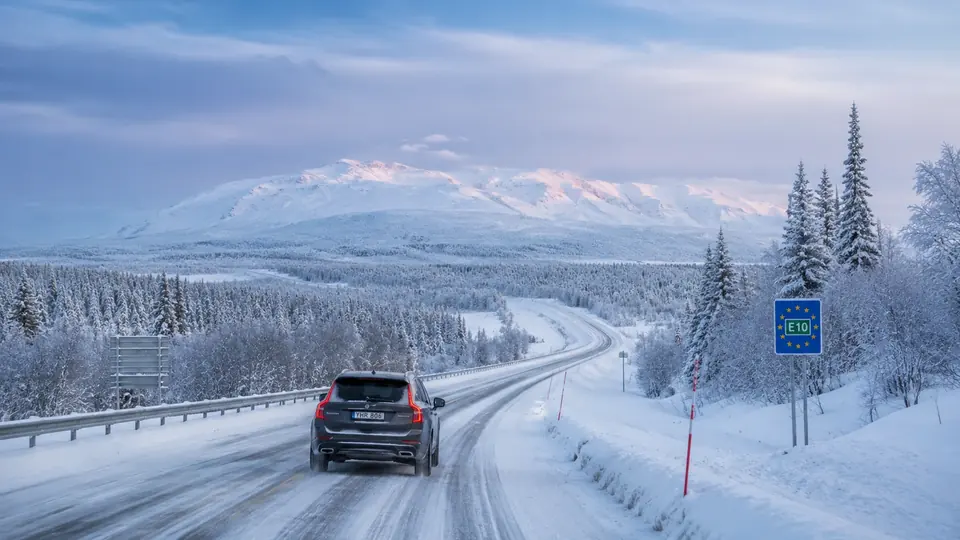
  • Well-plowed main roads — the E10 between Kiruna, Abisko and Narvik is cleared regularly.
  • Darkness for most of the day in December and January, with short twilight windows.
  • Reduced speed limits — you will drive slower than in summer, and that is normal.
  • Potential moose and reindeer near or on the road, especially at dawn, dusk and night.

The key difference between a stressful drive and a comfortable one is expectation management. If you expect to drive at summer speeds on bare asphalt, you will be surprised and scared. If you expect snow, slower speeds, longer stopping distances and darker roads, you will be fine. Thousands of tourists drive Kiruna’s winter roads every season without incident. You can too.

Local truth

What locals know

Locals do not drive with special superpowers. They just leave more space, brake earlier, and they always — always — do a brake test when starting a journey. More on that in a minute.

Why Studded Tires (Dubbdäck) Are Your Best Friend

If you only remember one thing from this guide, remember this: studded winter tires transform an Arctic road from scary to manageable. The difference between a standard all-season tire and a studded winter tire on ice is the difference between walking on polished marble in socks versus hiking boots with spikes.

In Sweden, winter tires are legally required from December 1 to March 31 (and sometimes earlier or later depending on weather). Most rental cars in Kiruna come equipped with studded tires — not the less-aggressive "nordic friction tires" (sometimes called "friktionsdäck") that are common further south. Studded tires have small metal pins that dig into ice and hard-packed snow, providing grip you can feel immediately.

How studded tires change the driving experience

  • Braking on ice: Studded tires reduce stopping distance by 30–50% compared to all-season tires.
  • Cornering confidence: The front end stays planted instead of sliding wide.
  • Hill starts: You can start on an icy slope without spinning wheels.
  • Sound: You will hear a light grinding or crackling noise on bare asphalt — that is normal and means they are working.

What to check before you drive away from the rental desk: Ask explicitly if the car has studded tires (dubbdäck). If it only has friction tires (friktionsdäck), the car is still legal but less capable on pure ice. For most winter visitors to Kiruna, studded tires are strongly preferred, especially if you plan to drive outside the main E10 highway.

Critical

The one tire mistake tourists make

Some visitors assume that a 4x4 or AWD (all‑wheel drive) makes winter tires optional. It does not. AWD helps you start moving — but it does almost nothing to help you stop. Stopping grip comes from tires, not from how many wheels are driven. A front‑wheel‑drive car with studded tires will stop far shorter than an AWD car with all‑season tires.

The Brake Test: The Single Most Useful Thing You Will Do

Here is the secret that experienced winter drivers use every time they get behind the wheel: the brake test. Before you drive any distance, find a safe, empty stretch of road (a parking lot, a quiet side street, or a straight section with no traffic behind you). Then, at low speed (20–30 km/h), press the brake pedal firmly until the ABS activates.

Why does this matter? Because you need to feel the grip — or lack of it — before you need to stop in an emergency. The brake test tells your brain how much grip the road has today. Ice with a thin layer of fresh snow feels different from polished ice, which feels different from packed snow. The brake test takes five seconds but changes how you drive for the rest of the trip.

How to perform the brake test

  1. Find an empty parking lot or a side road with no traffic behind you.
  2. Accelerate gently to about 20–25 km/h.
  3. Press the brake pedal firmly — not slamming, but with real pressure.
  4. Feel the ABS pulse through the pedal (that vibration is normal).
  5. Notice how long it takes to stop and whether the car tracks straight.
  6. Now you know today’s road surface. Adjust your speed and following distance accordingly.

I recommend doing a brake test at the start of every driving day, because road conditions change with temperature, snowfall, traffic and sunshine. A road that was wet slush at noon can be glare ice by 4 PM when the temperature drops. The brake test costs nothing and might save you from a collision.

Local driving routine

Every winter-driving local I know does an informal brake test within the first minute of driving. It is not a special course — it is just wisdom. When tourists ask me how locals drive so confidently on snow, I tell them: they know exactly how much grip they have because they tested it before they needed it.

Snow Walls, Road Narrowing & Plow Ridges

One of the biggest surprises for first-time Arctic drivers is how much the road shrinks in winter. Plowed snow builds up on the shoulders, creating walls of snow that define the edge of the drivable surface. In many places, the actual asphalt is narrower than in summer because snow banks have swallowed the margins.

This is not dangerous — it just requires a shift in perception. Here is what to expect:

  • White-on-white visibility: In heavy snow or twilight, the edge between road and snow bank can disappear. Look for reflector poles (usually orange or red) that mark the road edge.
  • Meeting oncoming traffic: When two vehicles pass on a narrow winter road, each driver should slow slightly and move toward their respective snow bank. Do not panic and steer into the ditch — the snow wall is usually soft, but staying centered is better.
  • Plow ridges at intersections: Where side roads meet main roads, snowplows often leave a hard ridge of compacted snow. Approach these at a 90‑degree angle if possible, and cross slowly to avoid scraping the car’s underside.
  • Frozen ruts: On smaller roads, tire tracks can freeze into hard ruts. If your wheels drop into a rut, do not fight it aggressively — let the car follow the rut and steer gently to exit when the rut ends.

The golden rule for snow walls and narrowed roads: slow down before the narrow section, not during it. Reduce speed before you meet an oncoming truck or before you enter a tight curve. Speed adjustment in winter happens early.

Moose & Reindeer: The Real Arctic Hazard

Ask any local what keeps them awake on winter roads, and they will not say "ice" or "darkness." They will say moose (älg) and reindeer (ren). These animals are unpredictable, difficult to see in darkness, and devastating in a collision.

Let me be direct: a collision with a moose at highway speed can be fatal. Moose are tall and dark; when you hit them, their body often comes through the windshield. Reindeer are smaller but still dangerous, and they travel in groups.

Moose survival rules

  • Slow down in moose zones. Warning signs (yellow triangles with a moose silhouette) are posted where moose are common. Treat every sign as serious.
  • Scan the shoulders. Moose often stand just off the road before crossing. Look for large dark shapes and reflective eyes.
  • Use high beams when alone. On dark, empty roads, high beams extend your view and help you spot animals earlier.
  • If a moose is on or near the road: Stop as far away as safely possible. Do not try to drive past slowly — moose are unpredictable and may jump toward the car.
  • If a collision is unavoidable: Brake firmly but do not swerve violently. Swerving can send you into a tree, a ditch, or oncoming traffic. Hitting the moose while braking hard is usually the less dangerous option.

Reindeer rules

Reindeer are semi-domesticated and belong to Sámi herders. They are often found near or on the road, especially around Jukkasjärvi, the E10 corridor, and anywhere with lichen. Reindeer are shorter than moose but can still cause serious damage and injury. Unlike moose, they often travel in herds — if you see one reindeer, expect more to follow.

Reindeer warning signs are also common. Reduce speed when you see them, use high beams when appropriate, and be especially careful at dusk and dawn when animals are most active.

Emergency numbers

If you hit an animal

Call the police (112) to report the collision. Do not leave an injured animal. If the animal is dead and blocking the road, move it to the shoulder only if it is safe to do so. Your rental car insurance usually covers animal collisions, but you need a police report.

Cold Starts: Starting Your Car at -30°C

One of the most common questions I hear from nervous drivers is: "What if the car does not start in the cold?" The good news is that rental cars in Kiruna are prepared for Arctic temperatures. Most have engine block heaters and cabins heaters (sometimes called "defa" or "defa heaters").

Here is what you need to know about cold starts:

  • Engine block heaters warm the engine oil, making cold starts easier and reducing engine wear. If your rental has one, there will be an electrical cord hanging from the front grille and a timer or switch inside. Plug in when the temperature drops below -15°C.
  • If the car is cold-soaked overnight (-25°C or lower): Turn the key to "on" (do not start yet), wait for the glow plug light to go out (diesel engines), then start. The engine may crank slowly but should start.
  • After starting: Do not rev the engine. Let it idle for 30–60 seconds, then drive gently. Modern cars do not need long warm-ups; gentle driving warms the car faster than idling.
  • If the car will not start: Call the rental company’s emergency number. Do not keep cranking — that drains the battery. Most rental companies have 24/7 assistance.
  • Remote starting: Some newer rentals have remote start apps. Ask at the rental desk if this is available.

For short stops (shopping, a meal), leaving the car for an hour at -20°C is usually fine. For longer stops in extreme cold, plug in if a outlet is available (many hotels, visitor centers and parking lots in Kiruna have electrical outlets for engine heaters).

Pro tip

Keep the gas tank half full

In extreme cold, condensation can form in an almost-empty fuel tank. More importantly, a half-full tank means you have a safety margin if you get stuck or if roads close. I recommend never letting the tank drop below a quarter in winter — and filling up before long drives to Abisko or Narvik.

Driving in Polar Darkness: Headlights, Reflections & Fatigue

From early December through early January, Kiruna experiences polar night — the sun does not rise above the horizon. Even outside this period, daylight is brief and weak. Most of your driving will happen in twilight or full darkness. This is not as difficult as it sounds, but it requires some adjustments.

Headlight rules in Sweden

Swedish law requires low-beam headlights at all times, day and night. Most modern cars have automatic lights that handle this, but if you rent an older car, check that the headlights are on whenever the engine runs.

High beam usage

On dark, empty roads (most roads around Kiruna at night), use high beams to extend your visibility. Dip to low beams when:

  • An oncoming car approaches (within about 300 meters).
  • You are following another car (to avoid blinding the driver ahead).
  • You enter a well-lit area (rare in the Arctic).

High beams are essential for spotting moose, reindeer and dark-clothed pedestrians. Use them generously when safe.

Fatigue in winter darkness

Driving in constant darkness is more tiring than daytime driving. Your eyes work harder, and the lack of natural light can affect your alertness. Take breaks every two hours, even if you do not feel tired. Stop at a rest area, get out of the car, walk for five minutes. Caffeine helps, but rest is better.

Snow reflection and glare

On sunny winter days (yes, the Arctic has bright, sunny days even in December), fresh snow reflects intense light. Wear good sunglasses. Glare can be blinding, especially when the sun is low on the horizon.

Speed, Following Distance & Winter Physics

The physics of winter driving is simple: cold tires + icy road + normal speed = long stopping distance. What changes is your behavior. Here are the non‑negotiable rules:

ConditionDry asphalt (summer)Packed snow / ice (winter)
Typical stopping distance at 70 km/h~45–55 meters~100–150 meters or more
Safe following distance (seconds)2–3 seconds5–8 seconds
Cornering speedPosted limit20–30% slower than posted
Braking techniqueProgressive pressureFirm + ABS pulsing is normal

The 5‑second rule

Pick a fixed point ahead (a sign, a tree). When the car in front of you passes that point, count "one thousand one, one thousand two…" You should reach that point no sooner than five seconds later. On very icy roads, stretch to eight seconds. This feels excessive to summer drivers. It feels correct to winter drivers.

Cornering without sliding

Complete your braking before you turn the steering wheel. Braking in a corner on ice can trigger a slide. Slow down on the straight approach, then steer smoothly through the corner, and accelerate gently when the car is straight again.

If you start to slide

Do not slam the brakes. Do not jerk the steering wheel. Look where you want the car to go, steer gently in that direction, and ease off the accelerator. Modern stability control (ESP) will help, but only if you give it time to work.

Overcoming Fear of Snow Driving: A Psychological Toolkit

Fear of winter driving is almost always about lack of familiarity, not actual danger. Once you understand what to expect and how to react, the fear drops dramatically. Here is a simple fear‑reduction protocol:

  1. Accept slower speeds. Driving at 60 km/h on a snowy road is not failure — it is wisdom. Speed limits are maximums, not targets.
  2. Give yourself permission to pull over. If you feel overwhelmed, find a safe place to stop (a gas station, a wide shoulder, a parking area). Breathe for two minutes. Then continue.
  3. Follow a local. If a local car passes you, keep a safe distance and follow their lines through corners. They know the road.
  4. Do not drive tired or rushed. Fatigue magnifies fear. Build extra time into every journey so you never feel pressured to drive faster than conditions allow.
  5. Remember: thousands do this every day. The same roads that scare you are daily commutes for families, nurses, delivery drivers and tour operators. If they can do it, you can too — with the right preparation.

Rental Car Checklist: What to Verify Before You Drive

Before you accept the keys, go through this checklist. It takes five minutes and prevents most rental‑related surprises.

  • Studded tires (dubbdäck): Confirm verbally and look at the tires. Studded tires have small metal pins visible in the rubber.
  • Tire tread depth: Legal minimum is 3 mm for winter tires, but deeper (5–6 mm) is much better. If the tires look worn, ask for a different car.
  • Ice scraper and snow brush: Must be in the car. Check before you drive away.
  • Engine block heater cord: Ask where it is and how to use it. Test that it is not frozen into the bumper.
  • Windscreen washer fluid: Should be winter formula (down to -30°C or lower). Spray the windshield to test.
  • Fuel type: Diesel or petrol? Know which one. Putting the wrong fuel in is expensive.
  • Spare tire or repair kit: Most rentals have a repair kit instead of a spare. Know where it is.
  • Lights: Check high beams, low beams, turn signals, rear lights, fog lights.
  • Heating: Turn on the cabin heater, heated seats, heated steering wheel (if available). Make sure they work.
  • Emergency number: Save the rental company’s 24/7 assistance number in your phone before leaving the lot.

Key Winter Routes: Kiruna to Icehotel, Abisko, Narvik

These are the roads most visitors will drive. Here is what to expect on each.

Kiruna town to Icehotel / Jukkasjärvi (approx 20 km, 20–25 minutes)

This is an easy warm‑up route. Mostly straight, well‑plowed, with moderate traffic. The road follows the Torne River. Watch for reindeer near Jukkasjärvi. The main challenge is the roundabout at the E10 junction — approach slowly, give way to traffic already on the roundabout, and do not rush.

Kiruna to Abisko (approx 95 km, 1 hour 15 minutes – 1 hour 45 minutes)

The E10 north from Kiruna to Abisko is the main Arctic highway. It is plowed regularly but exposed to wind, especially around Torneträsk lake. Sections can be icy. The landscape is spectacular, but do not let that distract you. Reduce speed before the curves near Abisko. There are few gas stations between Kiruna and Abisko — fill up before you leave.

Abisko to Narvik (Norway) (approx 85 km, 1 hour 15 minutes – 1 hour 45 minutes)

This route crosses the Norwegian border and includes the steep pass at Björnfjell. Norwegian winter roads are also well maintained, but the pass can be windy, icy and occasionally closed during storms. Check road conditions before driving this stretch. Norwegian speed limits are lower, and fines are high. Passports are not usually checked at the border (Schengen area), but carry your passport anyway.

Kiruna to Nikkaluokta (approx 65 km, 1 hour – 1 hour 30 minutes)

A smaller road that leads to the trailhead for Kebnekaise (Sweden’s highest mountain). This road is narrower, less frequently plowed, and can be bumpy with snow ridges. Drive slowly, be prepared to pull over for oncoming vehicles (rare), and watch for moose. This is a stunning drive on clear days, but not the road to rush.

Real‑time info

Check road conditions before every longer drive

Use Trafikverket’s website or app (Trafikverket.se) for live road conditions, weather warnings and cameras. Also check YR.no (Norwegian met office) for the Abisko–Narvik stretch. Do not rely on general weather apps — use the official road information.

What Locals Know That Tourists Don’t

I have spent years driving Kiruna’s winter roads, and here are the unspoken rules that experienced locals follow.

  • Do the brake test every day. I already said this, but it bears repeating because it is the single most useful habit.
  • Drive on fresh snow like it is ice. Fresh snow can hide ice underneath. Until you have tested grip, assume the worst.
  • Do not brake on a bridge. Bridges freeze before the rest of the road. Complete braking before the bridge, then coast across.
  • Warm air can mean ice. If the temperature rises to near freezing after a cold spell, roads can become treacherously icy. Drive even more carefully.
  • Keep a wool blanket in the car. If you break down, a blanket keeps you warm while you wait for help.
  • Tell someone your route. On remote stretches, let your hotel or a friend know when you expect to arrive.
  • Do not trust GPS travel times. GPS assumes dry summer speeds. Add 20–30% to estimated travel times in winter.
  • Respect truck drivers. Trucks need more space and take longer to stop. Do not cut in front of them. If a truck is behind you on a winding road, pull over at the next safe place to let it pass.

Emergency & Breakdowns: What to Do When Things Go Wrong

Even with good preparation, things can happen. Here is your emergency playbook.

If the car breaks down or you slide off the road

  1. Stay in the car. It is your shelter.
  2. Call roadside assistance (the number from your rental contract).
  3. If you cannot call and you are on a remote road, wait. Help will come eventually, but stay with the car.
  4. Run the engine periodically for heat (if exhaust pipe is clear of snow). Crack a window slightly to prevent carbon monoxide buildup.
  5. Use your hazard lights to make the car visible.

If you see an accident

Stop only if it is safe. Call 112 (European emergency number). Do not put yourself in danger to help. If you are not trained in first aid, the most helpful thing is to call for help, mark the accident location, and keep others away.

Winter survival kit for your rental

Most rentals do not include a full survival kit. Bring these items yourself or buy them in Kiruna:

  • Warm hat, gloves, extra sweater (keep in the car, not your suitcase).
  • Power bank for your phone.
  • Bottled water and snacks.
  • Small flashlight or headlamp.
  • Paper map (phones can fail in extreme cold).

Myth Busting: What You Have Heard About Arctic Driving (That Isn’t True)

Let me clear up some common misconceptions.

  • Myth: "Winter roads are closed all the time." False. Major roads like the E10 close only during extreme storms, and usually for a few hours at most. Most visitors never experience a closure.
  • Myth: "You need a 4x4 to drive in Kiruna." False. A normal front‑wheel‑drive car with studded tires is perfectly fine. 4x4 helps with deep snow and steep hills but is not necessary for main roads.
  • Myth: "Driving at night is too dangerous." False. Darkness does not change the road surface. With good headlights and adjusted speed, night driving is routine.
  • Myth: "You must drive very slowly everywhere." False. You drive at a speed that matches conditions. On well‑plowed, straight roads, 80–90 km/h can be perfectly safe. On icy curves, 40 km/h might be too fast. Conditions determine speed.
  • Myth: "Rental cars do not have real winter tires." Mostly false. In Kiruna, most rentals are equipped with proper studded winter tires. Always verify, but do not assume the worst.

Final Verdict: Should You Rent a Car in Kiruna Winter?

After reading this guide, you have the knowledge to make an informed decision. Here is my honest advice as a local:

Rent a car if: You want flexibility, you are comfortable with the idea of driving on snow (not necessarily experienced — just comfortable learning), you plan to explore beyond the town center, and you have read this guide carefully. With studded tires, the brake test, and adjusted speed, most drivers handle Kiruna’s roads without difficulty.

Do not rent a car if: You are deeply anxious about winter driving even after reading this guide, your trip is very short (2–3 days), or you plan to drink alcohol in the evenings (tours are better then). Also, if you are visiting only for a few days and staying in central Kiruna, taxis, transfers and tours may be cheaper and less stressful.

For the majority of winter visitors who want to see the Icehotel, chase the Northern Lights on their own schedule, and explore Abisko, renting a car is the right choice. Just prepare, drive gently, and respect the Arctic conditions.

Prefer Not to Drive? Let Us Take You There

Not everyone wants to drive in the Arctic, and that is completely fine. Kiruna Tours offers guided Northern Lights excursions, transfers to Icehotel and Abisko, and winter activities with pickup from your hotel. You see the same landscapes — without touching the steering wheel.

Sources & Further Reading

For real‑time road conditions, weather and official information, use these resources before and during your trip.

FAQ: Driving in Kiruna Winter

Do I really need studded tires?

Yes, strongly recommended. Studded tires provide significantly better grip on ice than friction tires or all‑season tires. Most Kiruna rental cars include them.

Is it safe to drive from Kiruna to Abisko in winter?

Yes, the E10 is a well‑maintained main road. Drive at appropriate speeds, watch for reindeer, and check road conditions before departure. Thousands of drivers use this route daily.

What should I do if I hit black ice?

Stay calm. Do not brake suddenly. Ease off the accelerator, keep the steering wheel straight, and wait for the tires to find grip again. Modern stability control helps.

How do I avoid moose collisions?

Slow down in moose warning zones, use high beams on dark roads, scan the shoulders, and be extra careful at dawn, dusk and night. If you see one moose, expect more.

Can I use my foreign driver’s license?

Yes, if it is in English, German, French or a Nordic language. Otherwise, an International Driving Permit (IDP) is recommended. EU licenses are fully valid.

What is the speed limit on winter roads?

General limits: 70 km/h on most rural roads (reduced from 80–100 km/h in winter), 50 km/h in urban areas, 110 km/h on a few motorway sections. However, you should drive much slower when conditions require.

How do I pay for fuel?

All gas stations accept international credit cards (Visa, Mastercard). Some require a PIN. Pre‑pay inside if your card does not work at the pump. Cash is rarely accepted at pumps.

What if I have never driven on snow before?

Start with short trips on quieter roads (e.g., Kiruna to Jukkasjärvi). Practice the brake test in a parking lot. Drive more slowly than feels necessary. After one day, you will gain confidence.

Is winter driving in Sweden more dangerous than in other Nordic countries?

Not at all. Swedish winter roads are well maintained, and driver training is high. The risk level is similar to Norway or Finland. The main difference is lower speed limits on winter roads.

What do I do if a blizzard starts while I am driving?

Reduce speed significantly. Turn on low beams (not high beams — high beams reflect off snow and reduce visibility). If visibility drops below a few car lengths, pull off the road at a safe place (not the shoulder — find a parking area or gas station) and wait for conditions to improve.