Short Answer Summary
February and March are the best overall months to visit Kiruna for a balance of daylight and Northern Lights. December offers polar-night atmosphere and blue-hour photography, while summer brings 24-hour daylight under the midnight sun.
Best Month to Visit Kiruna
Choose February or March for the best all-round winter experience. Choose December for polar night and atmospheric darkness. Choose May–July for the midnight sun and summer travel conditions.
What Makes Kiruna’s Light So Extreme?
Kiruna sits above the Arctic Circle in Swedish Lapland, close to mining regions such as LKAB’s operations and near aurora destinations like Abisko. This location creates extreme seasonal light cycles including polar night and midnight sun.
These light conditions directly shape travel planning, outdoor activities and Northern Lights visibility.
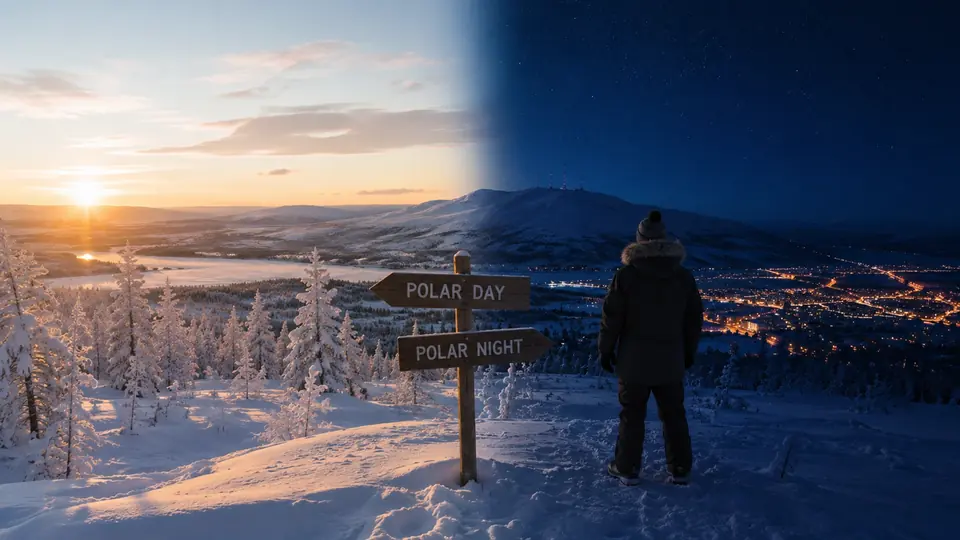
Polar Night in Kiruna
Polar night occurs around December 11–January 1, when the sun does not rise above the horizon. However, Kiruna still receives several hours of usable twilight each day.
| Time Period | Light Condition | Best Use |
|---|---|---|
| Morning | Darkness | Aurora viewing, indoor activities |
| Midday (10:00–14:00) | Blue-hour twilight | Photography, short tours, ICEHOTEL visits |
| Afternoon | Rapid darkness | Evening tours, aurora hunting |
Winter Months Compared
| Month | Best For | Main Advantage | Main Limitation |
|---|---|---|---|
| December | Polar night experience | Longest darkness and blue-hour atmosphere | Very limited daylight |
| January | Deep winter travel | Returning light and strong winter conditions | Cold and short days |
| February | Balanced winter travel | Daylight + aurora evenings | High demand |
| March | Photography + comfort | Longer daylight and stable weather | Later aurora timing |
Midnight Sun Period
From approximately May 28 to July 16, Kiruna experiences continuous daylight. The sun does not set, making this period ideal for hiking, fishing and road trips.
Important Note
Northern Lights are not visible during the midnight sun period due to continuous daylight.
Daylight and Northern Lights
Northern Lights require darkness, clear skies and solar activity. While winter provides long nights, cloud cover remains the most important factor for visibility.
| Season | Aurora Visibility | Best Strategy |
|---|---|---|
| Dec–Jan | Excellent darkness | Use long nights, but monitor clouds |
| Feb–Mar | Best balance | Daytime activities + evening aurora |
| Apr | Weakening | Early month only |
| May–Jul | Not visible | Midnight sun season |
Common Mistake
Many visitors focus only on daylight hours, but in Kiruna the real planning factor is light type: twilight, darkness or continuous daylight.
Solution
Match the month to your activity: December for atmosphere, February–March for balanced travel, summer for outdoor daylight experiences.
Traveling With Families
February and March are usually better for families because they offer daylight for outdoor activities while still maintaining winter conditions and aurora opportunities.
Photography Conditions
- December: Blue-hour winter landscapes
- February–March: Bright snow + activities
- Summer: Midnight sun landscapes
- Aurora: Requires winter darkness
Common Mistakes Visitors Make
- Assuming polar night is complete darkness 24/7
- Planning long sightseeing days in December
- Expecting aurora during summer
- Ignoring cloud conditions for aurora hunting
Final Verdict
February and March offer the most balanced experience in Kiruna. December is ideal for atmospheric polar night travel, while summer is best for continuous daylight and outdoor nature activities.