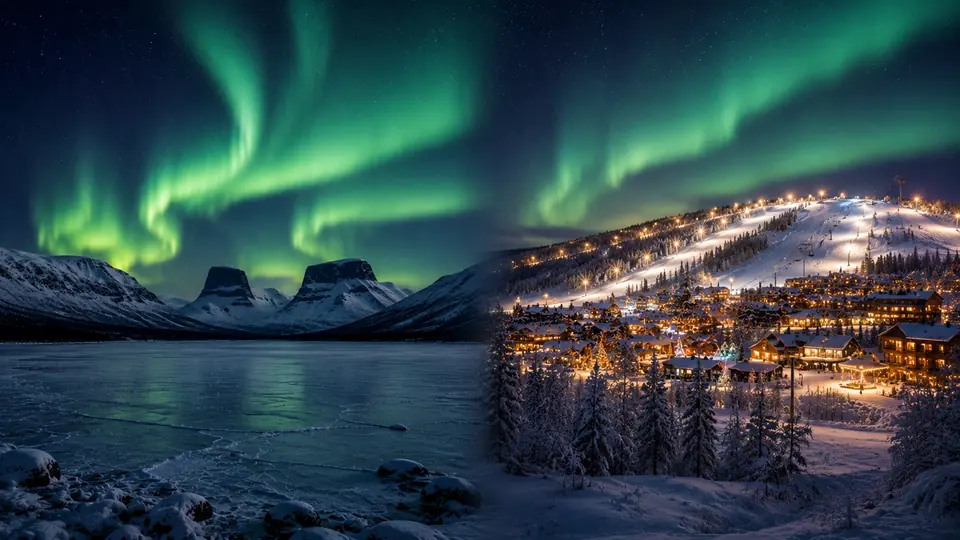
Where Are Abisko and Levi?
Abisko is located in Swedish Lapland approximately 100 km west of Kiruna, while Levi is located in Finnish Lapland approximately 170 km north of the Arctic Circle near Kittilä. Both destinations are among Europe's most famous Northern Lights locations but offer very different landscapes, infrastructure and travel experiences.
Abisko is best known for Abisko National Park, Lake Torneträsk, mountain scenery and its reputation for clearer winter skies. Levi is best known as one of Finland's largest ski resorts, with a wide range of glass igloos, winter activities, restaurants and family-friendly attractions.
For travelers whose main goal is seeing the Aurora Borealis, location matters because weather patterns, light pollution and landscape conditions can significantly influence the experience.
Many first-time aurora travelers overvalue KP index. A moderate display under clear sky is more useful than a high forecast hidden behind cloud. Check local cloud cover before deciding whether a night is promising.
Abisko vs Levi at a Glance
| Factor | Abisko | Levi |
|---|---|---|
| Dark-sky conditions | Very strong, low light pollution | Moderate light pollution from resort |
| Glass igloos | Very limited | Extensive, world-class selection |
| Skiing | Limited (cross-country) | Excellent (alpine and cross-country) |
| Restaurants and nightlife | Limited | Good selection |
| Aurora photography | Excellent, dark and simple | Good, requires positioning away from lights |
| Family activities | Limited | Extensive (kids' slopes, reindeer, Santa) |
| Quiet atmosphere | Very strong | Resort atmosphere |
Weather and Clear Skies
Cloud cover is the biggest practical obstacle in both destinations. The aurora can be active above you, but if the sky is covered, you will not see it. This is why local weather and mobility matter as much as solar activity.
Abisko is known for the local clear-sky tendency often called the Blue Hole effect. It can improve the odds around Abisko compared with surrounding areas, but it is not a promise. Levi has a more continental Finnish Lapland climate, which can be cold and stable but also subject to cloud systems moving in from the Atlantic.
| Weather Factor | Abisko | Levi |
|---|---|---|
| Climate type | Inland Arctic, mountain-influenced | Continental Arctic, forest-influenced |
| Cloud challenge | Still possible, but often better clear-sky odds | Moderate cloud frequency |
| Aurora strategy | Wait in dark locations when local sky is open | Drive to darker spots or use glass igloo |
Aurora Photography
Abisko is easier for clean dark-sky aurora photography. The compositions are usually built around Lake Torneträsk, snow, forest and mountain silhouettes. Levi can produce excellent photographs, particularly from glass igloos or from elevated viewpoints on the ski slopes, but beginners often struggle more with light pollution from the resort.
| Photography Factor | Abisko | Levi |
|---|---|---|
| Darkness quality | Excellent | Good (away from resort) |
| Foreground options | Lake, mountains, Lapporten | Glass igloos, ski slopes, forest |
| Weather reliability | Higher (Blue Hole effect) | Moderate |
The most common mistake is choosing the destination with the strongest online reputation without matching it to personal travel style. A ski resort traveler may find Abisko too limited. A quiet nature traveler may find Levi too busy and bright.
Glass Igloos and Accommodation
One of the biggest practical differences between these destinations is glass igloo availability. Levi has invested heavily in aurora-themed accommodation and offers numerous glass igloo properties. Abisko has a very limited selection of similar experiences.
| Glass Igloo Factor | Abisko | Levi |
|---|---|---|
| Selection | Very limited | Extensive |
| Price range | High (near Kiruna) | Moderate to high |
| Aurora viewing from bed | Limited | Widely available |
If staying in a glass igloo is a priority for your Lapland trip, Levi is the stronger choice. However, Abisko offers more traditional mountain station and guesthouse accommodation at generally lower price points.
Activities and Atmosphere
Abisko feels sparse, quiet and nature-led. Levi feels lively, resort-oriented and activity-rich. This matters because the Northern Lights are never guaranteed; the surrounding experience must still make sense if the sky stays quiet.
The Atmosphere in Abisko
Abisko feels remote, quiet and closely connected to the surrounding Arctic landscape. Most visitors spend their days hiking, snowshoeing, exploring Abisko National Park or joining outdoor excursions before searching for the Northern Lights after dark.
The Atmosphere in Levi
Levi is a functioning ski resort with year-round residents, shopping areas, restaurants, bars and tourist attractions. The resort welcomes a much larger number of visitors each winter and offers a wider variety of activities beyond Northern Lights viewing.
Winter Activities Compared
| Activity | Abisko | Levi |
|---|---|---|
| Alpine skiing | No | Yes (extensive) |
| Cross-country skiing | Excellent | Excellent |
| Snowmobiling | Available | Extensive |
| Reindeer experiences | Available | Available |
Travelers sometimes choose Levi expecting a remote wilderness experience. While beautiful Arctic nature exists nearby, the resort itself feels significantly more developed and urban than Abisko.
Costs, Accessibility and Logistics
Typical Costs
Both destinations are expensive during peak winter season. Levi often has higher accommodation costs for glass igloos but more budget options overall. Abisko can become expensive because supply is limited and transfers from Kiruna add cost.
| Cost Category | Abisko | Levi |
|---|---|---|
| Hotels | Limited, moderate to high | Wide range, moderate to high |
| Glass igloos | Very limited, high | Extensive, moderate to high |
| Restaurants | Limited, moderate | Good variety, moderate |
Getting There
Levi is relatively easy to reach via Kittilä Airport (KTT), approximately 15 km from the resort. Direct flights from several European destinations operate during winter. Abisko usually requires travel through Kiruna Airport (90 km) with an additional train or transfer.
| Travel Factor | Abisko | Levi |
|---|---|---|
| Nearest airport | Kiruna (90 km) | Kittilä (15 km) |
| Additional transfer required | Usually (train/bus/car) | Rarely (taxi/shuttle) |
| Convenience for short trips | Moderate | Excellent |
Best Months for Northern Lights
The aurora season runs from late September to early April. For most travelers, February and March offer the best combination of dark nights, manageable temperatures and longer daylight for daytime activities.
Which Destination Should You Choose?
Choose Abisko If
- Your main goal is seeing the Northern Lights
- You want the highest probability of clear skies
- You prefer a quiet, remote atmosphere
- You are a serious aurora photographer
- You want to avoid crowds
Choose Levi If
- You want a glass igloo stay
- You are traveling with children
- You want to combine aurora viewing with skiing
- You prefer a resort with restaurants and activities
- You want easier airport access
- Choose Abisko for darker skies and aurora focus
- Choose Levi for glass igloos and skiing
- Stay at least three nights
- Check cloud forecast before KP index
- Book peak winter accommodation early
No destination can guarantee Northern Lights sightings. The best strategy is to view the aurora as one part of a complete Arctic experience.
Final Verdict
For pure Northern Lights focus, Abisko is usually the better choice. It is darker, quieter and better suited to travelers who want to spend evenings watching the sky without a resort around them.
For glass igloos, skiing and family holidays, Levi is usually the better choice. It has excellent glass igloo accommodation, ski slopes, restaurants, family activities and easier logistics.
Neither destination can guarantee aurora sightings. The best strategy is to view the aurora as one part of a complete Arctic experience that includes winter activities, local culture and time spent outdoors.